Planting Strawberries (Crowns, Fruiting Types, and Crown Depth)
Why strawberries are planted from bare-root crowns rather than seed, how to choose between June-bearing, everbearing, and day-neutral types, and the crown-depth rule that determines success.
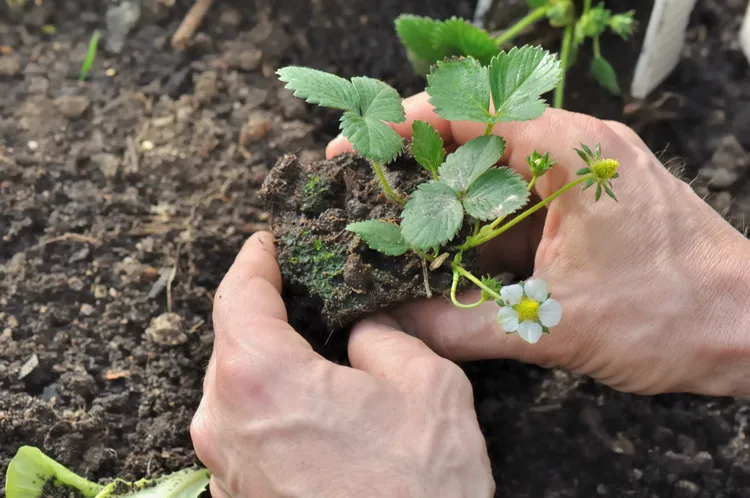
Strawberries are almost never started from true seed in a home garden, and for good reason. Seed-grown strawberries are slow to establish, genetically unpredictable since strawberries don't reliably breed true from seed, and take an extra full season longer to fruit than a plant started from a bare-root crown or nursery transplant.
Crowns, Not Seeds
A strawberry crown is a dormant, bare-root plant, typically sold in late winter or early spring, consisting of a compressed stem with roots below and dormant leaf buds above. This is the standard starting point for a home patch, and it's what most of this framework assumes when referring to "planting" strawberries. Named varieties propagated this way, rather than grown from seed, guarantee the plant matches the specific characteristics, flavor, size, disease resistance, that the variety was selected for.
Choosing a Fruiting Type Before Planting
Strawberries fall into three fruiting categories, covered in more depth in our growing guide, and the choice matters at planting time since it affects spacing and how much runner space to leave. June-bearing varieties produce one concentrated harvest in early summer and send out the most runners. Everbearing varieties produce two or three smaller flushes through the season with fewer runners. Day-neutral varieties fruit continuously through the growing season regardless of day length, with the fewest runners of the three. A first-time grower wanting a single big harvest for preserving leans toward June-bearing; a grower wanting a steady trickle of fresh fruit through the season leans toward day-neutral.
When to Plant
Bare-root crowns are planted in early spring, as soon as the soil can be worked and frost risk has mostly passed, giving roots time to establish before summer heat arrives. In milder climates, fall planting is also an option, giving plants a head start before the following spring's growing season, though this requires enough mild weather remaining for roots to establish before winter dormancy.
Soil Preparation
Strawberries want well-draining, slightly acidic soil (pH 5.5 to 6.8) rich in organic matter. Raised beds or mounded rows are particularly well suited to strawberries specifically because they improve drainage, and poor drainage is one of the more common causes of crown rot in a home strawberry patch. Working compost into the bed before planting improves both drainage and the steady nutrient supply strawberries need through a long fruiting season.
The Crown-Depth Rule
Planting depth matters more for strawberries than for almost any other crop in this framework, and getting it wrong in either direction causes real problems. The crown itself, the compressed stem where roots meet leaves, needs to sit exactly at soil level, not buried and not exposed. Planted too deep, the crown can rot from excess moisture and soil contact; planted too shallow, with roots exposed above the soil line, the plant dries out and struggles to establish. Spreading roots out in a shallow hole and mounding soil gently around the crown, checking that the crown itself remains visible at the surface, is the standard technique for getting this right.
Spacing
Spacing depends heavily on the fruiting type chosen and how runners will be managed. June-bearing varieties, which send out the most runners, are often planted farther apart (18 to 24 inches / 45 to 60cm) to leave room for the matted row system that lets runners fill in naturally. Day-neutral and everbearing varieties, producing fewer runners, are often planted closer together (12 inches / 30cm) in a more controlled hill system. Our growing guide covers these systems in more depth.
Container and Raised Bed Growing
Strawberries grow well in containers, raised beds, and even dedicated strawberry pots with multiple planting pockets, making them one of the more space-flexible crops in this framework for a gardener without a dedicated in-ground bed. Container-grown strawberries dry out faster than in-ground plants and need more frequent watering, but otherwise follow the same crown-depth and spacing principles as an in-ground planting.
Frequently Asked Questions
Can I grow strawberries from grocery store fruit seeds? Technically the tiny seeds on a strawberry's surface are viable, but named varieties don't breed true from seed, meaning the resulting plant is unlikely to resemble the parent fruit; this approach is really only worth trying out of curiosity, not as a serious way to establish a productive patch.
How long until a newly planted crown produces fruit? Most guidance recommends removing flowers in the first season entirely, covered in the growing guide, meaning a meaningful harvest typically doesn't arrive until the second spring after planting, though everbearing and day-neutral types sometimes allow a modest first-year harvest if a portion of flowers is left intact later in the season.
Is it better to buy crowns or nursery starts in pots? Bare-root crowns are cheaper and available in larger quantities, suited to filling a full bed; potted nursery starts cost more per plant but establish somewhat faster and are more forgiving for a first-time grower planting just a few plants.
Do strawberries need a different bed each year like some vegetables? A well-maintained strawberry bed can stay productive for 3 to 5 years before quality and yield decline enough to warrant starting a fresh planting, longer than the annual rotation many vegetables in this framework need.
A Simple Planting Checklist
- Source bare-root crowns or potted nursery starts of a named variety.
- Choose a fruiting type, June-bearing, everbearing, or day-neutral, that matches your goals.
- Prepare well-draining, slightly acidic soil rich in organic matter.
- Plant in early spring, with the crown sitting exactly at soil level.
- Space according to fruiting type and planned runner management system.
Thinking Beyond the First Season
Because a strawberry bed can stay productive for several years, decisions made at planting, variety choice, spacing, and site selection, have consequences that echo across multiple seasons rather than just one, more like the multi-year thinking that suits a fruit tree or perennial herb than the season-to-season planning that suits an annual vegetable.
Comparing Bare-Root Crowns to Potted Starts in Practice
Bare-root crowns arrive dormant and require prompt planting, ideally within a few days of receiving them, and should be kept cool and their roots kept moist (not soaking wet) until planting. Potted nursery starts are already actively growing and more forgiving of a slight planting delay, though they typically cost more per plant, a tradeoff worth weighing based on how many plants a given bed calls for.
Frequently Asked Questions
What if my seed rhizome doesn't sprout during the pre-sprouting window? This question doesn't apply to strawberries in the way it does to rhizome crops; if a bare-root crown fails to show any green growth within a few weeks of planting in warm soil, it's reasonable to treat it as non-viable and replace it rather than continuing to wait.
How many crowns should a beginner start with? A dozen or so crowns is a reasonable first planting, enough to learn the crown-depth and runner-management basics without overcommitting to an unfamiliar multi-year crop.
Does crown size at planting affect eventual productivity? Larger, healthier crowns with more visible root mass generally establish more vigorously than small or dried-out ones, worth inspecting before planting and prioritizing the sturdiest crowns from a batch if some variation in quality is visible.
Is it necessary to treat crowns with anything before planting? Most home growers plant crowns untreated with good results; soaking roots briefly in water before planting, just enough to rehydrate them if they've dried out slightly in shipping, is a reasonable and commonly recommended step.
Planning Ahead for Multiple Seasons at Planting Time
Because a strawberry bed can remain productive for 3 to 5 years, it's worth choosing a planting location that won't be needed for another purpose in the near future, unlike the annual rotation planning that suits many of the vegetables covered elsewhere in this framework.
Sourcing Multiple Varieties
Planting more than one variety, perhaps a June-bearing type for a concentrated harvest suited to jam-making alongside a day-neutral type for a steady trickle of fresh fruit, gives a household access to both the flush of the growing types covered in this framework, similar in spirit to the mixed-variety planting suggested for garlic elsewhere in this content series.
What Success Looks Like at This Stage
By the end of the first growing season, success isn't a plant covered in fruit, since flowers should have been removed; it's a healthy, well-rooted crown that's sent out a reasonable number of runners and shows vigorous green growth heading into its first winter.
Thinking Ahead to the Harvest Stage
Decisions made at planting, fruiting type, spacing, site drainage, echo forward through every later stage covered in this guide, particularly harvest timing and the volume of fruit a bed eventually produces at once. Taking the extra time to plant correctly pays off across the several years a well-maintained bed can remain productive.
Comparing Regional Nursery Sources
Local nurseries and regional seed suppliers often stock varieties specifically selected for good performance in the local climate, generally a more reliable starting point than a generic national catalog listing for a first-time strawberry grower unfamiliar with which varieties perform well in their specific conditions.
What Success Looks Like at This Stage, Revisited
Success at planting isn't a flawless outcome for every crown; a reasonable survival rate, healthy green growth by early summer, and correct crown depth across the majority of plants give a bed a strong realistic foundation for the productive years ahead.
Patience With a Perennial Crop
For gardeners used to annual vegetables with a single-season payoff, strawberries' multi-year establishment period can feel unfamiliar at first, sacrificing a first-year harvest for the sake of a stronger plant. Trusting this process, rather than second-guessing the flower-removal guidance, sets up considerably better results in the seasons that follow.
Keeping a simple written record of planting date, variety, and fruiting type each time a new bed goes in makes it considerably easier to track a patch's expected productive lifespan and plan for eventual renovation or replacement years down the line.
Realistic First-Season Expectations
A first strawberry planting rarely produces a picture-perfect bed by the end of its first season; some variation in crown survival and early runner development is normal, and a modest, uneven first year of growth is still a genuine success worth building on toward the following year's first real harvest.
Planting strawberries for the first time asks for a kind of patience many other garden crops don't, sacrificing an entire first season's fruit for the sake of a stronger plant later. Trusting that process is what separates a productive, long-lived bed from a rushed one that never quite reaches its potential.
Every small success along the way, healthy roots taking hold, a crown surviving its first winter, builds confidence for the seasons of fruiting that follow.
As with the other perennial and long-season crops covered across this content series, ginger among them, the real payoff of careful planting comes months or even years later, a delayed gratification that's easy to underestimate at the moment a small, dormant crown first goes into the ground.
By the time outdoor planting day arrives, that early research and preparation has already set the stage for everything that follows across the years ahead.
Trusting an Unfamiliar Timeline
Gardeners accustomed to fast-fruiting annual vegetables sometimes feel discouraged watching a strawberry bed's first season pass without any harvest at all; recognizing that this is normal and expected for the crop, not a sign of trouble, helps maintain the right mindset through that quiet first year.
A confident, well-researched start makes everything that follows easier across the years ahead.
Every good bed starts with this same careful attention to timing and depth.
Take the time now, and the payoff shows up for years.
A Brief Comparison to Other Crops
Compared to the rhizome propagation covered for ginger or the clove-based approach covered for garlic elsewhere in this content series, strawberry crown planting is its own distinct method entirely, closer in spirit to planting a young perennial shrub or tree than to any of the other propagation approaches covered so far in this framework.
Latest









