Calcium and Bone Density: The Perimenopause Nutrition Priority No One Talks About
Bone resorption accelerates from the first year of irregular periods - years before most women think about bone health. The dietary window for making a difference is earlier than expected, and the food strategy is more specific than 'drink more milk'.
Most women think about bone health at menopause, when they are told to start taking calcium supplements. The biology of bone loss does not wait that long. Bone resorption begins accelerating in the first year or two of irregular periods - the beginning of perimenopause. This can be a decade before the final menstrual period. The window during which dietary calcium has the most meaningful protective effect opens earlier than most women are told, and how much it matters depends significantly on what calcium status looks like going into the transition.
What Oestrogen Does for Bone
Oestrogen regulates bone remodelling - the continuous cycle of bone resorption (breakdown by osteoclast cells) and bone formation (building by osteoblast cells). In the presence of adequate oestrogen, this cycle is roughly balanced. As oestrogen declines, osteoclast activity outpaces osteoblast activity, and net bone loss occurs. The rate of loss is highest in the two to three years immediately following the final menstrual period (when oestrogen drops most steeply), but it begins during the perimenopausal fluctuation phase.
Women can lose 1-3% of bone mineral density per year in the first three to five years post-menopause, compared to 0.3-0.5% in pre-menopausal women. Over a decade, this compounds to a significant structural change. Fracture risk - particularly hip, spine, and wrist - rises substantially. The dietary goal is not to prevent all bone loss (that requires hormonal intervention) but to ensure that the raw materials for bone maintenance are consistently available so that loss is minimised under declining hormonal conditions.
How Much Calcium You Actually Need
The recommended daily calcium intake in perimenopause and post-menopause is 1,000-1,200mg. Most UK and US women consume approximately 600-700mg daily. The gap between actual intake and requirement is wide, and supplement-only approaches to closing it are less effective than a food-first strategy - because calcium from food is absorbed in smaller, more frequent doses, which is more physiologically efficient than a single large supplement bolus.
The target is 3-4 calcium-rich food servings daily, spread across meals. One serving means approximately 250-300mg calcium.
The Best Calcium Sources (With Absorption Caveats)
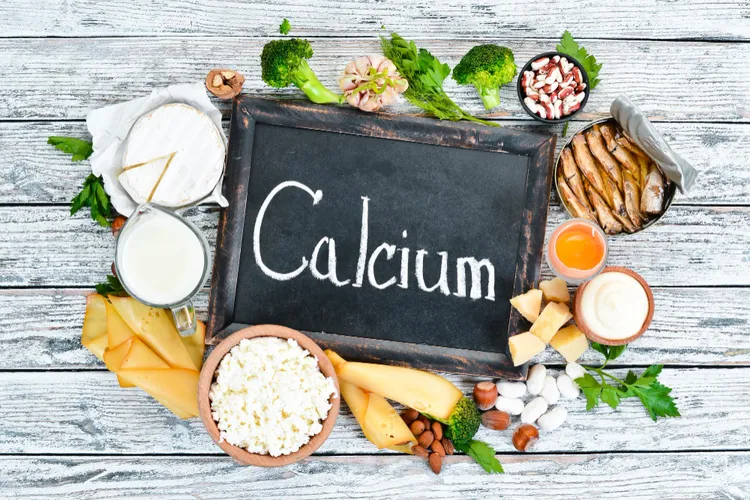
Dairy (high calcium, high bioavailability): Full-fat yoghurt (230mg per 200g), hard cheese (200-300mg per 30g, depending on type), milk (240mg per 250ml), cottage cheese (130mg per 200g). Dairy calcium is approximately 30-35% bioavailable - meaning a 300mg serve provides roughly 90-100mg absorbed calcium. Full-fat dairy has no meaningful disadvantage for bone health and the fat improves absorption of vitamin D, which is essential for calcium utilisation.
Canned fish with bones (often overlooked): Canned sardines with bones (350mg per 100g), canned salmon with bones (220mg per 100g). This is a highly bioavailable calcium source frequently missed in bone health guidance. The five-minute sardines with olives provides approximately 300mg calcium per serving alongside the omega-3 benefit.
Calcium-set tofu (variable, read the label): Tofu made with calcium sulphate (listed in ingredients as 'calcium sulphate' or 'E516') can provide 200-400mg per 100g. Tofu set with magnesium chloride (nigari) contains very little calcium. The difference is significant and the label check takes 10 seconds.
Dark green vegetables (moderate calcium, variable bioavailability): Kale (150mg per 100g cooked, approximately 50% bioavailability), pak choi (105mg per 100g, high bioavailability), broccoli (40mg per 100g, moderate bioavailability). Spinach contains 99mg per 100g cooked but its high oxalate content reduces calcium bioavailability to approximately 5% - making it a poor calcium source despite being frequently cited as one.
Fortified plant milks: Most fortified oat, almond, and soy milks provide 120-240mg per 250ml. Shake the carton well before use - the calcium carbonate used for fortification settles at the bottom.
Almonds: 76mg per 30g. A useful contribution to daily totals when eaten as a regular snack.
Vitamin D: The Calcium Absorption Partner
Calcium absorption is regulated by active vitamin D (calcitriol). Without adequate vitamin D, calcium absorption from food can fall to 15% even from high-bioavailability sources. The UK recommendation of 10 micrograms (400 IU) daily is widely considered inadequate for the post-40 population - many bone health specialists suggest 1,000-2,000 IU, particularly in northern latitudes where endogenous production from sunlight is minimal for much of the year.
Food sources of vitamin D are limited (oily fish, egg yolks, fortified foods). For most women in perimenopause in northern climates, vitamin D supplementation through winter months is appropriate and evidence-supported for bone health. A blood test for serum 25-hydroxyvitamin D gives the most accurate picture of individual status.
What Does Not Work as Well as Marketed
High-dose calcium supplements (1,000mg+ in a single dose) have become controversial. A 2011 meta-analysis raised concerns about cardiovascular risk from large calcium supplement boluses, and while subsequent analysis suggested the risk increase was modest and context-dependent, the picture shifted toward food-first calcium with supplements used only to close specific gaps rather than as a substitute for dietary intake. If supplementing, calcium citrate is better absorbed than calcium carbonate (particularly for women taking acid-suppressing medications or with reduced stomach acid), and doses above 500mg should be split across two sittings.
The complete perimenopause dietary framework is in the perimenopause kitchen guide. For how calcium interacts with protein and phytoestrogens for overall bone health, the evidence on phytoestrogens is in the phytoestrogens article.
Beyond Calcium: The Full Bone Health Nutrient Profile
Calcium and vitamin D are the most discussed bone health nutrients, but several others play important supporting roles that are relevant to perimenopause nutrition:
Magnesium: Required for vitamin D activation and for bone mineralisation. Approximately 60% of the body's magnesium is stored in bone. Magnesium deficiency impairs the conversion of inactive vitamin D to its active form, meaning that vitamin D supplementation is less effective in magnesium-deficient individuals. The best food sources - dark green vegetables, legumes, pumpkin seeds, whole grains - are also calcium-contributing foods, making dietary magnesium and calcium naturally co-occurring.
Vitamin K2: Directs calcium into bone and teeth rather than into soft tissues and arteries. Menaquinone-7 (MK-7) is the most bioavailable form and is found in fermented foods - particularly natto (fermented soybeans, very high content), and to a lesser extent in hard cheeses, egg yolks, and fermented dairy. The evidence for vitamin K2 in bone health has strengthened over the past decade, with several trials showing improvements in bone mineral density and markers of bone formation. Including fermented foods and cheese alongside calcium-rich foods covers this nutrient without supplementation for most women.
Protein: As noted in the protein article, adequate protein is positively associated with bone mineral density and calcium absorption. Low protein intake impairs bone matrix synthesis regardless of calcium intake.
The practical implication: bone health in perimenopause is best supported by a dietary pattern that simultaneously covers calcium, vitamin D, magnesium, vitamin K2, and protein - not by calcium supplementation in isolation. The full perimenopause kitchen framework addresses all of these simultaneously.
Weight-Bearing Exercise: The Non-Dietary Requirement
Dietary calcium and vitamin D provide the raw materials for bone. Weight-bearing and resistance exercise provides the mechanical stimulus that signals the body to use those materials to build and maintain bone density. Osteoblasts (bone-building cells) are stimulated by mechanical loading - the impact and resistance forces placed on the skeleton during exercise. Without this stimulus, the dietary investment in calcium and vitamin D produces less of the bone density benefit that the nutrients are capable of providing. Walking, jogging, dancing, tennis, strength training, and yoga all qualify. Swimming and cycling, while excellent for cardiovascular and general health, provide less bone density stimulus because the skeleton is supported by water or the bike. The dietary and exercise components of bone health in perimenopause are complementary, and neither is fully effective without the other.
Calcium and the Perimenopause Timeline
The earlier bone density protection begins, the more reserve a woman enters menopause with - and the more time before osteoporosis-level bone density is reached. Bone mass peaks in the late 20s and early 30s; from the late 30s there is slow loss even in pre-menopause; from perimenopause onset the rate accelerates significantly. A woman who enters perimenopause with high peak bone mass and who maintains adequate calcium, vitamin D, protein, and weight-bearing exercise through the transition will reach post-menopause with substantially higher bone density than a woman who did not - even if the rate of loss during the transition is similar. The dietary investment in bone health is most effective when it starts early, and it remains relevant throughout the transition and beyond. The perimenopause kitchen framework in the complete guide covers calcium as one of six evidence-based nutritional priorities for the transition, each of which becomes more important rather than less as oestrogen declines.
DEXA Scanning: When to Request It
DEXA (dual-energy X-ray absorptiometry) scanning measures bone mineral density and is the clinical gold standard for assessing fracture risk. In the UK, DEXA scans are not routinely offered until post-menopause - typically when osteoporosis risk factors or a fragility fracture prompt it. However, for women with specific risk factors - early menopause (before 45), family history of hip fracture, long-term corticosteroid use, low body weight, eating disorder history, or malabsorption conditions - requesting a baseline DEXA scan in perimenopause is clinically reasonable.
Knowing bone density at the start of the transition provides a baseline against which to assess rate of loss, informs the urgency of dietary and lifestyle intervention, and creates the data needed for evidence-based decisions about pharmacological bone protection if required. If you have risk factors, raise this specifically with your GP rather than waiting for post-menopausal screening. The dietary priorities in this article - calcium, vitamin D, magnesium, vitamin K2, protein, weight-bearing exercise - are appropriate regardless of scan status, but having the data focuses the urgency appropriately. For the complete perimenopause dietary framework, the complete guide covers all six nutritional priorities.
The Daily Calcium Practice
Covering 1,000-1,200mg calcium daily through food requires deliberate inclusion at two to three meals - it does not happen passively in a typical Western diet. Building the habit of identifying the calcium source at each meal is the simplest implementation strategy. Breakfast: yoghurt or milk (240-280mg). Lunch: a sardine or salmon meal, or a calcium-set tofu dish, or a dark green vegetable side (150-350mg depending on source). Dinner: dairy in a sauce, cheese on a salad, or kale alongside a main (150-200mg). Three intentional calcium inclusions cover the daily target without requiring specific recipes or significant dietary change. The investment in this habit is a direct investment in the bone density that will determine fracture risk 20 years from now. For the full perimenopause dietary framework, the complete guide covers calcium alongside all other evidence-based nutritional priorities.
The Case for Starting Now
Every year of the perimenopause transition in which calcium intake falls short of 1,000-1,200mg daily is a year in which bone mineral density loss is not being maximally mitigated. The loss that occurs in those years is largely irreversible through dietary means - dietary calcium cannot rebuild density that has already been lost, it can only slow the ongoing rate of loss. The window in which dietary calcium has its greatest protective effect is during the transition itself, before density loss becomes significant. Starting now - building the two to three calcium-source-per-day habit from early perimenopause - protects the peak bone mineral density going into the most vulnerable post-menopausal years more effectively than beginning after density has already declined. For the full perimenopause nutritional framework, the complete guide covers all six evidence-based priorities.
The three-stage approach - food first for the majority of calcium, vitamin D supplementation to ensure absorption efficiency, and calcium supplements only to close documented gaps rather than as a primary strategy - is the most evidence-consistent framework for perimenopause bone health. For the complete nutritional picture, the perimenopause kitchen guide covers calcium alongside all other evidence-based priorities for the transition.
Medical disclaimer: This article is for informational purposes only and does not constitute medical advice. Perimenopause affects every woman differently, and dietary changes should complement, not replace, guidance from your GP or a qualified healthcare professional. If you are experiencing significant symptoms, please seek medical support.
Latest