How to Tell When Jam Is Set: Wrinkle Test, Spoon Test, Temperature
Three reliable methods for testing jam setting point - and what to do when none of them give you a clear answer.
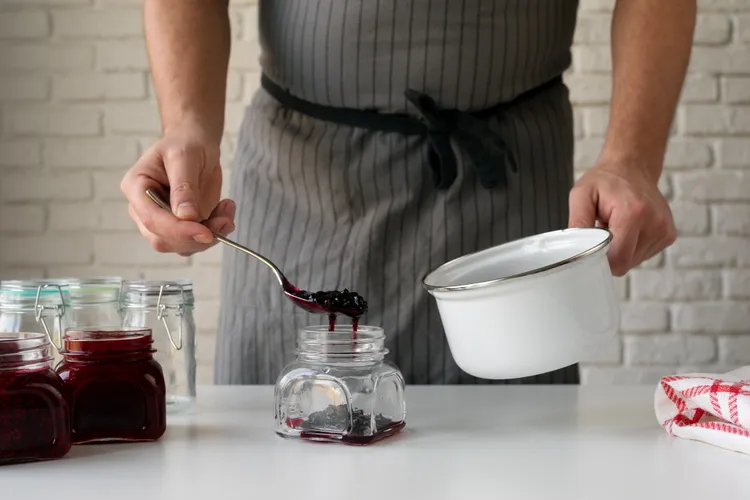
Most batches of jam that fail do so because the cook did not test confidently or tested too late. The setting point is a narrow window - roughly 104 to 106 degrees Celsius - and it passes faster than most people expect. Here are all three tests, how to read each one, and what to do when the results are ambiguous.
Method 1: The Wrinkle Test (Most Reliable)
Put two small saucers in the freezer before you start cooking. When you think the jam might be ready, take the pan off the heat - jam keeps cooking while you test - drop a teaspoon of jam onto the cold saucer, and wait 30 seconds. Then push the edge of the pool with your fingertip. If the surface wrinkles, you have a set. If it flows back into a smooth puddle, it is not ready. Return the pan to the heat, boil for another 3 minutes, and test again on the second saucer.
The cold saucer is essential. Testing on a room-temperature surface gives a false result - the jam needs to cool fast to mimic how it will behave in a sealed jar.
Method 2: The Spoon Test (Secondary Check)
Lift a wooden spoon from the boiling jam and hold it horizontally. Under-set jam drips in separate drops from the edge. Setting jam forms a sheet that hangs and falls as one piece. Set jam falls in one thick sheet that hangs for a moment before dropping. The spoon test is less precise than the wrinkle test but useful as a first signal that you are getting close.
Method 3: Sugar Thermometer (Consistent, Not Infallible)
Setting point for jam is 105 degrees Celsius (221 degrees Fahrenheit). Clip a sugar thermometer to the side of the pan so the bulb is submerged in jam but not touching the bottom. Once you hit 105 degrees, do the wrinkle test to confirm. Thermometers can be slightly miscalibrated, and fruit with varying pectin levels can set at slightly different temperatures. Use the thermometer to know you are close, then trust the wrinkle test to confirm.
To check your thermometer's accuracy: boil water and note the temperature. At sea level it should read 100 degrees Celsius. If it reads 98 degrees, your setting point target is 103 degrees. Adjust accordingly.
When the Tests Disagree
Thermometer says 105 degrees but wrinkle test shows no set: boil for 3 more minutes and test again. This happens with high-water-content fruit or low-pectin batches. Wrinkle test looks positive but temperature is only 102 degrees: the wrinkle test wins. Set the jam. The wrinkle test is testing actual behaviour, not a proxy.
Recipe: Quick Setting-Point Practice Batch (Gooseberry Jam)
Gooseberries are ideal for practising the set test - they are very high in pectin and acid and set decisively. This batch is small enough to cook quickly but large enough to use all three tests in sequence.
Makes: 3 to 4 x 340g jars | Prep: 10 minutes | Cook: 15 to 20 minutes
Ingredients
- 750g green gooseberries, topped and tailed
- 600g white granulated sugar
- 150ml water
Instructions
- Put two saucers in the freezer. Sterilise jars at 120 degrees Celsius for 15 minutes.
- Combine gooseberries and water in a heavy-based pan. Bring to a simmer over medium heat. Cook for 10 minutes until berries are completely soft and beginning to burst.
- Add sugar, stir over low heat until fully dissolved. Increase to a rolling boil.
- Clip in your sugar thermometer. Boil hard, skimming foam. Start testing at the 8-minute mark.
- Watch the spoon test change from drops to sheet - this happens fast with gooseberries. Once you see the sheet, do the wrinkle test immediately. The thermometer will likely be reading 104 to 105 degrees at this point.
- Remove from heat. Let stand 3 minutes. Ladle into warm jars. Seal immediately.
Why Setting Point Is a Range, Not a Fixed Number
105 degrees Celsius is the target, but setting point in practice is a range from about 103 to 107 degrees depending on the fruit, the altitude, and the batch size. High-pectin fruit such as gooseberries and blackcurrants can set firmly at 103 degrees. Low-pectin fruit with added commercial pectin might need 106 degrees. The wrinkle test captures this variability in a way the thermometer alone cannot - it tests the actual behaviour of the jam rather than a proxy temperature.
Batch Size and Setting Time
Large batches take longer to reach setting point because more liquid needs to evaporate. A 2kg batch might need 20 to 25 minutes of rolling boil where a 500g batch took 10. Keep the heat high, keep skimming, and keep testing. Do not panic and assume something is wrong - the jam will get there.
Altitude and Thermometer Calibration
At 300 metres above sea level, water boils at 98.9 degrees Celsius rather than 100 degrees. This means your target setting temperature drops by the same differential - approximately 103 degrees rather than 105 degrees. The wrinkle test accounts for altitude automatically since it tests set directly. The thermometer needs manual adjustment. Check your thermometer in boiling water, note the actual reading, and calculate your adjusted target by subtracting the deficit from 105 degrees.
Over-Set Jam
If jam sets too firm - it is almost solid in the pan, or sets in the jar before you can fill them all - it can sometimes be rescued. Pour it back into the pan, add 2 to 3 tablespoons of water per 500g of jam, and reheat gently while stirring until it loosens. Re-test. This does not always work on very over-set batches but is worth trying. For full rescue options including what to do when jam is completely liquid, see the jam troubleshooting guide.
Reading Ambiguous Results
Sometimes the wrinkle test gives a soft, unclear result - not clearly set, not clearly liquid. In this case, boil for 3 more minutes and retest. Use the second cold saucer so you are testing at the right temperature. If the result is still ambiguous after 3 minutes more, test with the spoon and look for the sheet behaviour. Two positive indicators from two methods means you are done.
Nutrition (per tablespoon, gooseberry jam)
- Calories: approximately 48 kcal
- Carbs: 12g
- Protein: 0g
- Fat: 0g
For the full context on pectin, sugar ratios, and every other aspect of jam-making, see the complete homemade jam guide.
The Cold Plate: The One Thing Worth Buying
You do not need specialist equipment for jam-making except possibly a sugar thermometer. But if you have ever forgotten to put a saucer in the freezer and tried to test on a room-temperature plate, you know how unreliable it is. The jam looks set on a warm surface, goes into the jar, and 24 hours later it is still liquid. Keep two small side plates in the freezer once you start the jam cooking. The cold surface is not a trick - it is genuinely what creates the conditions to see whether the jam will set at kitchen temperature.
Setting Point for Marmalade vs Jam
Marmalade follows the same setting point temperature as jam - 105 degrees Celsius - but takes longer to reach it because of the high water content from the extended peel-softening stage. The wrinkle test is the same. What changes is the interpretation: marmalade at the wrinkle test often has a slightly softer wrinkle than a high-pectin berry jam. This is normal. A set marmalade is not as firm as a set gooseberry jam. If it wrinkles at all and holds for 30 seconds, jar it. It will firm up as it cools. For more on marmalade technique specifically, see the citrus marmalade guide.
Practice Fruit for Learning the Test
The best fruit for learning the wrinkle test is gooseberry or blackcurrant. Both are very high in pectin and set decisively - the wrinkle is clear and unambiguous. Once you know what a definite positive looks like on these, you can calibrate your eye for the softer, less decisive wrinkling of a strawberry or plum jam. Low-pectin fruit sets more softly at first and the wrinkle can be subtle. If you have only ever made strawberry jam, you may not recognise a soft-but-real set when you see it. Make a gooseberry or blackcurrant batch as a calibration exercise and the rest becomes much clearer. For full jam technique from fruit selection through storage, see the complete homemade jam guide.
Setting Point by Fruit Type: Quick Reference
Understanding how different fruits set helps you know what to expect when testing. High-pectin fruits including blackcurrants, gooseberries, and quinces set very firmly at 105 degrees and sometimes at 104. The wrinkle test will show a clear, immediate wrinkle that almost crinkles. Medium-pectin fruits including plums, apricots, and early raspberries set well at 105 degrees and give a clear but less dramatic wrinkle. Low-pectin fruits including strawberries, cherries, and late-season blackberries require careful acid management and sometimes added pectin - they set at 105 degrees but the wrinkle is softer and slower to appear. Test on the second cold saucer, not the first, if you are not sure.
Marmalade sets at the same temperature but the wrinkle looks different because the peel pieces give the jam texture. Judge the liquid part of the jam on the saucer rather than the peel. A clear wrinkle in the liquid portion alongside peel that holds in place rather than running is a good set. For context on how this fits into the full jam-making process, the complete homemade jam guide covers every stage from fruit to sealed jar.
The Temperature-Wrinkle Agreement
When both the thermometer and the wrinkle test agree, you have a set. When they disagree, trust the wrinkle test. This happens because setting point is affected by factors the thermometer cannot account for: the dissolved sugar concentration, the pectin source, the altitude, and the specific calibration of your thermometer. The wrinkle test is a direct test of the behaviour you want - a gel that holds its shape at room temperature. The thermometer is an indirect proxy measurement. Both are useful, but when they conflict, the wrinkle test is the more accurate indicator of whether the jam will set in the jar. Use the thermometer to know when to start testing. Use the wrinkle test to know when to stop cooking.
Quick Reference Summary
This article is one of 12 guides in the CookThisMuch homemade jam series. The complete article, The Home Cook's Complete Guide to Making Jam from Scratch, covers the full framework: pectin types, sugar ratios, setting point science, sterilisation methods, water bath canning, and storage shelf life by type. Each cluster guide in the series, including this one, covers a specific fruit, technique, or problem in depth with a tested recipe. Whether you are making your first single jar or working through a summer glut of stone fruit, the technique is the same: soft fruit first, sugar second, rolling boil to setting point, hot jar, sealed lid. The details within that sequence are what this series covers, article by article, so you have a reliable reference for every variation you will encounter in a season of jam-making at home.
All recipes in this series use standard kitchen equipment. None require specialist preserving pans, pressure canners, or commercial-grade ingredients. The most useful single investment for anyone making jam regularly is a digital sugar thermometer with a clip. Beyond that, a heavy-based pan, clean glass jars, and two cold saucers in the freezer are all you need to produce consistently good results.
Setting Point: The One-Line Summary
Put two saucers in the freezer. Cook to a rolling boil. Test every 2 minutes from 8 minutes. Take the pan off the heat during each test. A wrinkle that holds for 30 seconds on a cold saucer is a set. Jar immediately. This is the full process. Everything else in this guide is context, calibration, and troubleshooting for the moments when the simple version does not tell you enough. But for 90 percent of jam batches, the process above is all you need. The other 10 percent is what the rest of this guide, and the complete homemade jam guide, are for.
Latest