Cooking With Others: The Mental Health Benefits of Shared Meals
Cooking and eating together is one of the most consistently documented predictors of social wellbeing across cultures. Here is what the research shows - and how to use the kitchen as a tool for building real connection.
Shared meals are among the oldest and most universal human rituals. Long before cooking was about nutrition or efficiency, it was about gathering - the fire as a meeting place, the meal as an act of belonging. That evolutionary context matters. The psychological benefits of cooking and eating with others are not incidental; they are built into how the brain processes social experience.
What Happens in the Brain During Shared Cooking
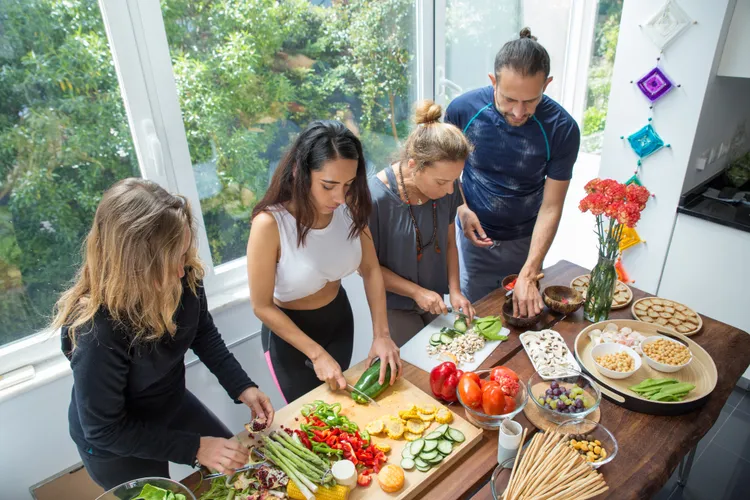
Collaborative activities - working toward a shared goal with other people - release oxytocin, the neuropeptide associated with bonding and trust. Cooking together is particularly effective because it involves genuine interdependence: someone chops while someone else stirs, conversations happen over tasks, there is a shared product at the end that everyone contributed to.
Sharing food activates a separate mechanism: reciprocity. The act of giving someone food you have made, and receiving food they have made, is processed by the brain as a form of mutual care. This is why meals are used to mark important social events across every culture - the food is the medium through which the relationship is expressed.
The Loneliness Problem and What Cooking Can Do About It
Loneliness is now recognised as a significant public health issue, associated with outcomes as serious as smoking in terms of mortality risk. Social isolation affects people across all demographics, but particularly single-person households, people working remotely, and older adults.
Shared cooking provides structured social contact that does not require conversation as the primary activity. For people who find purely social situations anxiety-provoking, the task-orientation of cooking can lower the barrier considerably. Having something to do together - a recipe to follow, vegetables to prep, a dish to assemble - takes the pressure off maintaining continuous dialogue and allows connection to develop more naturally.
Cooking as a Social Architecture
Some practical ways to use cooking as a vehicle for social connection:
- Weekly communal cooking. A standing arrangement to cook with a friend or housemate once a week - not just eat together, but cook together - builds a reliable anchor of social contact into the week.
- Cooking for someone in difficulty. Bringing food to someone who is ill, grieving, or overwhelmed is one of the most effective acts of care available. It communicates concern in a concrete, practical form that does not require the recipient to be socially available.
- Recipe exchange. Cooking a dish from a different cultural background and sharing it with someone who knows that cuisine - or asking someone to teach you one of their family recipes - creates an exchange with genuine depth.
Recipes That Work Well for Communal Cooking
Some dishes are naturally suited to collaborative cooking because the prep can be divided and the result scales easily.
The pressure cooker chicken and rice is a good example - one person handles the aromatics and spices while another preps the chicken, and the dish itself is substantial enough to feed a group properly. The balsamic chicken and mushrooms is similarly divisible and produces something impressive enough that cooking it together feels like an occasion.
For a more relaxed, lower-stakes communal cook, the leek, potato and lentil soup is forgiving, scalable, and involves enough prep work (leek cleaning, potato dicing) that there is always something for both people to do.
When Eating Alone Is Unavoidable
The reality for many people is that shared meals are not a daily option. The goal in that case is not to solve the isolation through cooking alone, but to maintain the practice of cooking properly so that when communal eating does happen, you are bringing something to the table - literally and figuratively.
For strategies around solo cooking specifically, see cooking for one: fighting loneliness in the kitchen. For the full context of how cooking supports mental health, see the complete guide to cooking as a mental health practice.
Latest