Low-Sugar Jam: How to Make Jam with Less Sugar
Sugar does more than sweeten jam - it sets and preserves it. Here is how to reduce it without losing your set or shortening shelf life beyond what is safe.
Sugar in jam is not optional in the way it is in most baking. At 60 to 65 percent sugar concentration, jam is microbiologically shelf-stable. Drop below that and you have made a flavourful sauce that needs to live in the fridge. Understanding what sugar actually does helps you reduce it strategically rather than just cutting it and hoping for the best.
What Sugar Does in Jam
Three things. First, it binds water molecules, starving bacteria and mould of the moisture they need to grow - this is what makes sealed jam shelf-stable at room temperature. Second, it interacts with pectin to form the gel structure, since pectin molecules will not link up properly without sufficient sugar present. Third, it provides sweetness. The first two are functional; the third is the one you can negotiate with.
The minimum sugar-to-fruit ratio for a reliably shelf-stable jam is roughly 60:40 (sugar to total weight). Most traditional recipes aim for 65:35. Reducing below 55 percent puts you in refrigerator jam territory.
Option 1: Pomona's Universal Pectin
Pomona's is calcium-activated rather than sugar-activated, which means it sets independently of sugar concentration. You can make a set jam with as little as 100g of sugar per 1kg of fruit. It gives a slightly different, softer set than traditional jam and some people find the flavour cleaner - there is less sugar to cover the fruit. Available online and in specialist cook shops.
Follow the Pomona's instructions precisely - the calcium water preparation is a separate step that most people get wrong the first time.
Option 2: Honey or Maple Syrup
You can substitute up to 50 percent of the sugar with honey or maple syrup. Go above 50 percent and the flavour of the sweetener overtakes the fruit. Both add complexity - try acacia honey with apricot, or dark maple syrup with blackberry. The jam will still need to reach 105 degrees Celsius and set normally. Use the same total weight of sweetener as you would sugar.
Honey contains more water than granulated sugar, so the jam needs to cook slightly longer to drive off excess moisture before reaching setting point. Strong-flavoured honeys like buckwheat or manuka will dominate the fruit flavour, which may or may not be what you want.
Option 3: Refrigerator Jam (No Compromise)
If you do not need shelf stability, you can make a genuinely low-sugar jam designed for fridge storage. Use 400g sugar per 1kg fruit. It will not be shelf-stable but it will set, taste intensely of fruit, and keep in the fridge for 3 to 4 weeks. This is the simplest approach for anyone who wants to reduce sugar without buying specialist pectin.
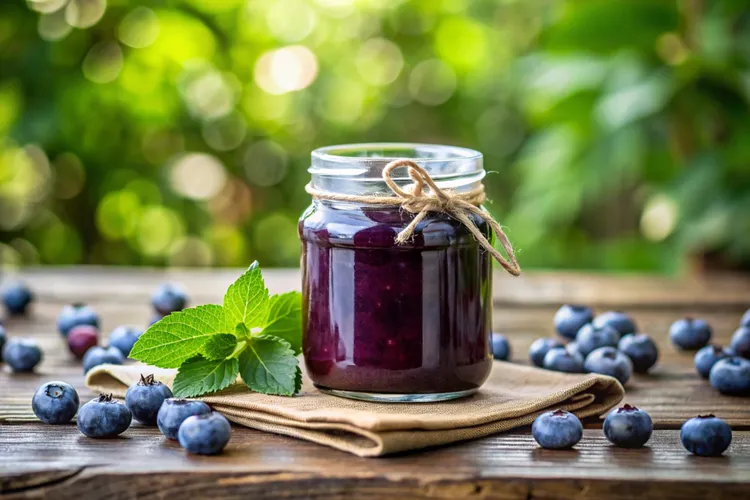
Recipe: Low-Sugar Blueberry and Lemon Jam
This uses Pomona's pectin for a proper set at reduced sugar. If you do not have Pomona's, make it as a refrigerator jam using the reduced-sugar method.
Makes: 3 to 4 x 340g jars | Prep: 15 minutes | Cook: 20 minutes
Ingredients
- 1kg fresh or frozen blueberries
- 300g white granulated sugar (or 250g sugar plus 3 tablespoons honey)
- 3 tablespoons lemon juice
- Zest of 1 lemon
- 1 sachet Pomona's Universal Pectin with calcium water - or omit and reduce sugar to 400g for a fridge jam
Instructions
- If using Pomona's, prepare calcium water as directed on the packet.
- Combine blueberries and lemon juice in a heavy pan. Cook over medium heat for 10 minutes, mashing as you go, until fruit is soft and juicy.
- Add calcium water if using Pomona's and stir in.
- Combine sugar, lemon zest, and Pomona's pectin powder in a bowl, mix well, then add to the pan. Stir constantly over high heat.
- Bring to a full rolling boil and boil for exactly 1 to 2 minutes. Pomona's sets faster than traditional pectin - do not over-boil.
- If making a standard fridge jam without Pomona's: add 400g sugar to the cooked fruit, dissolve, bring to rolling boil, and cook until wrinkle test passes, approximately 10 to 15 minutes.
- Ladle into sterilised jars. Pomona's jams benefit from refrigeration even when sealed - they have a softer set that holds better cold.
The Microbiological Reality of Low-Sugar Jam
Traditional jam is shelf-stable because sugar concentration reaches around 65 percent, creating water activity too low for most bacteria and moulds to grow. Below 55 percent, you are in a different preservation category. This is not cause for alarm - it means your low-sugar jam needs refrigeration, not that it is unsafe. The acidity from lemon juice still inhibits most pathogenic bacteria. What you get at lower sugar is a product more prone to mould growth over time, which is why low-sugar jam has a shorter refrigerator shelf life of 3 to 4 weeks versus 4 to 6 weeks for standard opened jam.
Texture Differences in Low-Sugar Jam
Reduced-sugar jam sets differently from traditional jam. With less sugar participating in the pectin gel structure, the set tends to be softer and more spreadable. Some people prefer this. Pomona's pectin produces a more firm gel because it does not depend on sugar for activation, but the texture is different from traditional pectin-sugar jams - it can feel slightly stiffer and less glossy. Neither is wrong; they are different products suited to different uses.
Sweeteners That Do Not Work
Artificial sweeteners such as aspartame and sucralose cannot replace sugar in jam. They provide sweetness but not the preservation, water-binding, or gel-forming functions. Xylitol and erythritol also fail to set pectin and do not preserve in the same way. Coconut sugar works as a 1:1 replacement for granulated sugar in terms of function, though it adds a molasses-like flavour and darkens the jam considerably.
Shelf Life of Low-Sugar Jam
Pomona's jam in sealed jars: 3 to 4 months in the pantry, longer in the fridge. Refrigerator jam made at 400g sugar per 1kg fruit: 3 to 4 weeks refrigerated only. Traditional jam made at 800g sugar per 1kg fruit: 12 to 18 months sealed, 4 to 6 weeks once opened. For more on storage and shelf life, see the homemade jam storage guide.
Nutrition (per tablespoon, reduced-sugar version)
- Calories: approximately 30 kcal
- Carbs: 7g (of which sugars 6g)
- Protein: 0g
- Fat: 0g
For the complete picture on pectin, setting point, and traditional jam technique, see the complete homemade jam guide.
Labelling Low-Sugar Jam Clearly
If you are gifting low-sugar or Pomona's jam, label it clearly with storage instructions. A recipient who leaves a low-sugar jam on the pantry shelf for six months after receiving it as a gift will have a jar of mould. The words "refrigerate, use within 3 months" on the label take two seconds and prevent confusion. The shelf life difference from traditional jam is not obvious from looking at the jar - it looks exactly the same. Make sure the information travels with it.
Low-Sugar Jam in Cooking
Low-sugar jam is more versatile as a cooking ingredient than traditional jam because it is less sweet. Use it as a glaze for grilled chicken or pork without the result tasting like dessert. Stir it into yoghurt for a breakfast that is not as cloying as standard jam. A teaspoon in a vinaigrette adds fruit flavour without the sweetness becoming dominant. The blueberry lemon version above works particularly well in these applications - the lemon acidity keeps it savoury-adjacent. For the full picture on jam technique including setting point and storage, see the complete homemade jam guide.
Testing a Low-Sugar Set
Low-sugar jam using Pomona's pectin behaves differently during the wrinkle test than traditional jam. The set is softer - a positive wrinkle from a Pomona's batch looks less firm than from a 65-percent-sugar blackcurrant jam. This is normal. A soft but clear wrinkle that holds for 30 seconds on a cold saucer is a passed test. Do not keep boiling it to try to get a firmer result - over-boiled Pomona's jam becomes rubbery. The setting temperature is also slightly lower, so the thermometer is less reliable here than usual. Stick to the wrinkle test as your primary indicator. Refrigerator jam (no Pomona's, just reduced sugar) follows the standard wrinkle test and sets normally. For the full setting point testing method, see the jam setting point guide.
Low-Sugar Jam: Frequently Asked Questions
Can I use a standard jam recipe and just reduce the sugar?
Yes, but the result will not be shelf-stable and may not set. Reduce to 400g sugar per 1kg fruit (the refrigerator jam approach) and accept a 3 to 4 week fridge shelf life. Below 400g per 1kg, setting becomes unreliable with standard pectin and the sugar concentration is too low for safe storage at any temperature beyond a few days.
Can I use stevia or another sweetener?
No - artificial sweeteners do not perform the preservation or gel-forming functions of sugar.
Does low-sugar jam taste better?
Often, yes - you can taste more of the fruit. The very high sugar in traditional jam masks some flavour nuance. This is a genuine quality trade-off, not just a health one.
Does low-sugar jam cost more to make?
Slightly less on the sugar, potentially more if you buy Pomona's pectin. Over multiple batches the cost difference is negligible.
For technique context including how sugar interacts with pectin and preservation, the complete homemade jam guide covers the full picture.
Pairing Low-Sugar Jam with Foods
Low-sugar jam's less sweet profile makes it more versatile with savoury foods than standard jam. A low-sugar blueberry jam pairs well with sharp cheddar in a way that a very sweet jam would not. Reduced-sugar apricot jam works on a cheese board alongside blue cheese. Low-sugar raspberry jam is excellent on a crumpet with salted butter where the saltiness and the fruit flavour are balanced without excessive sweetness. These pairings work because the jam's sugar content is lower, letting the fruit flavour take the lead rather than the sweetness. Standard jam is better for sweet applications - on scones with clotted cream, inside a Victoria sponge, in a trifle. Use each version where its character works best.
Quick Reference Summary
This article is one of 12 guides in the CookThisMuch homemade jam series. The article The Home Cook's Complete Guide to Making Jam from Scratch, covers the full framework: pectin types, sugar ratios, setting point science, sterilisation methods, water bath canning, and storage shelf life by type. Each cluster guide in the series, including this one, covers a specific fruit, technique, or problem in depth with a tested recipe. Whether you are making your first single jar or working through a summer glut of stone fruit, the technique is the same: soft fruit first, sugar second, rolling boil to setting point, hot jar, sealed lid. The details within that sequence are what this series covers, article by article, so you have a reliable reference for every variation you will encounter in a season of jam-making at home.
All recipes in this series use standard kitchen equipment. None require specialist preserving pans, pressure canners, or commercial-grade ingredients. The most useful single investment for anyone making jam regularly is a digital sugar thermometer with a clip. Beyond that, a heavy-based pan, clean glass jars, and two cold saucers in the freezer are all you need to produce consistently good results.
Low-Sugar Jam at a Glance
The three viable approaches: refrigerator jam at 400g sugar per 1kg fruit (3 to 4 weeks fridge, no shelf stability), Pomona's Universal Pectin with as little as 100g sugar per 1kg fruit (soft set, 3 to 4 months pantry or longer in fridge), honey or maple syrup substituting up to 50 percent of the sugar (standard set, 12 months sealed if processed). Each trades something - shelf life, set firmness, cost, or ingredient availability - for reduced sugar. None of them are compromised products; they are different products with different appropriate uses. Choose based on how you plan to store and use the jam. For technique context and the full picture on pectin and sugar interactions, see the complete homemade jam guide.
Making Low-Sugar Jam in Batches
Low-sugar jam is better made in smaller batches than traditional jam because its shorter shelf life means you need to consume it more quickly. A 500g batch of low-sugar blueberry jam gives 2 jars, which is realistic to finish within 3 to 4 weeks for a household that eats jam regularly. A full kilogram batch gives 4 jars, which is possible but requires consistent use. If you want to make low-sugar jam in larger quantities, make multiple small batches over a few weeks rather than one large batch. This keeps each jar as fresh as possible and spreads the sugar reduction across your jam supply without ending up with 8 jars that all need eating by the same date. For small-batch technique that pairs well with low-sugar approaches, see the small-batch jam guide.
Latest