Eating Less Meat the Mediterranean Way (Without Noticing)
The Mediterranean diet does not eliminate meat - it repositions it. Meat becomes a flavouring and a supporting player rather than the centrepiece of the plate. Two full recipes show exactly how this works: a slow-cooked lamb and white bean stew and a vegetable-forward chicken tray bake.
The most common objection to reducing meat consumption is that meals feel incomplete without it - less satisfying, less substantial, somehow less like dinner. The Mediterranean approach sidesteps this problem entirely. Rather than replacing meat with a meat substitute or reducing portion sizes, it changes the logic of the plate: the legume or vegetable takes the centre, and the meat flavours the dish from a supporting role. The result does not feel like deprivation because the meal is not structured around absence - it is structured around abundance of vegetables, legumes and grains, with meat as one of several flavour contributors.
How the Proportion Shift Works
In a standard Western dinner, meat occupies roughly half the plate - 150-200g as the focal point, with vegetables and starch as accompaniments. In a Mediterranean meal, that proportion inverts: a large quantity of beans or vegetables, a moderate amount of grain, and perhaps 80-100g of meat that flavours the dish rather than defining it. The calorie content of the meal may be similar; the ratio of plant to animal protein changes dramatically.
Two techniques accomplish most of this shift: slow cooking (where a small amount of meat infuses a large quantity of vegetables and legumes with flavour) and the tray bake (where vegetables are the bulk of the dish and protein is distributed evenly throughout rather than sitting on top).
1. Slow-Cooked Lamb and White Bean Stew
A one-pot stew built on white beans with lamb as the flavouring element. The lamb provides richness and depth; the beans provide protein, body and satiety. Total meat per serving: about 80g - enough to taste throughout every bite without dominating.
Ingredients (serves 6)
- 400g bone-in lamb shoulder, cut into large chunks (ask the butcher)
- 3 tbsp olive oil
- 2 onions, diced
- 4 garlic cloves, sliced
- 2 carrots, diced
- 2 celery stalks, diced
- 1 tsp dried rosemary (or 2 fresh sprigs)
- 1 tsp dried thyme
- 2 bay leaves
- 1 x 400g can chopped tomatoes
- 2 x 400g cans cannellini beans, drained and rinsed
- 500ml chicken or lamb stock
- Salt and black pepper
- Extra virgin olive oil and fresh parsley to finish
Instructions
- Season the lamb generously. Heat 2 tbsp olive oil in a large, heavy casserole over high heat. Brown the lamb on all sides in batches - do not crowd the pan. Remove and set aside.
- Reduce heat to medium. Add the remaining olive oil and cook the onion, carrot and celery for 10 minutes until softened.
- Add the garlic, rosemary, thyme and bay leaves. Cook for 2 minutes.
- Return the lamb to the pot. Add the tomatoes and stock. Bring to a simmer, cover and cook over the lowest possible heat for 1.5 hours until the lamb is completely tender and falling off the bone.
- Add the beans and cook for a further 20 minutes uncovered, so the beans absorb the stew juices and the sauce reduces slightly.
- Remove the bay leaves and any large bones. Taste and adjust seasoning generously. Serve in deep bowls with a drizzle of extra virgin olive oil, fresh parsley and bread.
Nutrition per serving: ~380 kcal | 28g protein | 14g fat | 35g carbs
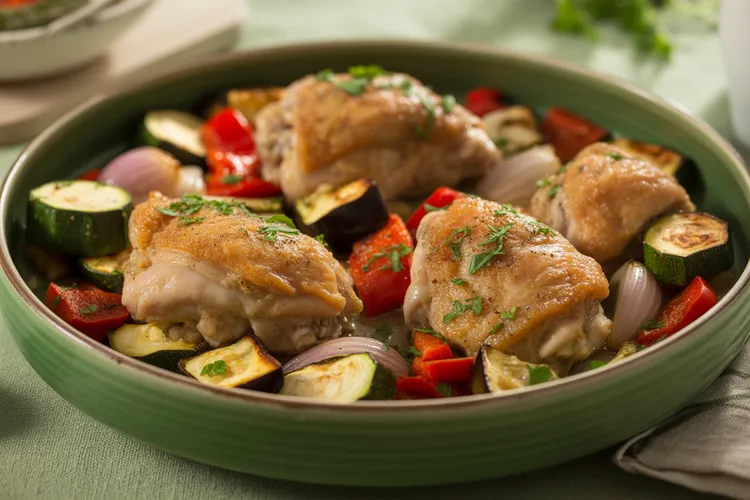
2. Vegetable-Forward Chicken Tray Bake
A tray bake where the ratio of vegetables to chicken is deliberately reversed from the norm: a large quantity of roasted vegetables with chicken pieces distributed through them. The chicken fat bastes the vegetables as they roast; the vegetables flavour the chicken. Neither element could taste as good without the other.
Ingredients (serves 4)
- 4 chicken thighs, bone-in and skin-on
- 1 large aubergine, cut into chunks
- 2 courgettes, cut into chunks
- 2 red peppers, deseeded and cut into chunks
- 1 large red onion, cut into wedges
- 1 x 400g can chickpeas, drained and rinsed
- 4 garlic cloves, unpeeled
- 1 lemon, cut into wedges
- 4 tbsp extra virgin olive oil
- 1.5 tsp dried oregano
- 1 tsp smoked paprika
- 0.5 tsp ground cumin
- Salt and black pepper
- Fresh parsley and crumbled feta to serve (optional)
Instructions
- Preheat the oven to 200°C / 400°F. Combine the olive oil, oregano, paprika, cumin, salt and pepper in a large bowl.
- Add the aubergine, courgettes, peppers, onion and chickpeas to the bowl and toss well to coat. Spread in a single layer across a large roasting tin or two trays - do not crowd them.
- Season the chicken thighs and nestle them among the vegetables, skin side up. Tuck in the garlic cloves and lemon wedges.
- Roast for 40-45 minutes until the chicken skin is deep golden and the thigh meat is cooked through (juices run clear when the thickest part is pierced), and the vegetables are tender and caramelised at the edges.
- Squeeze the roasted garlic from its skins over the dish, scatter with parsley and feta if using, and serve directly from the tray.
Nutrition per serving: ~420 kcal | 32g protein | 22g fat | 24g carbs
The Mindset Shift
Neither of these recipes requires willpower or a sense of sacrifice. The lamb stew is as satisfying as any meat-centred stew - more so, because the beans give it a body and substance that a pure meat stew does not have. The tray bake is a complete meal from a single pan. The reduction in meat is invisible in the eating; it shows up only in the ratio on the plate and in the shopping bill.
For the broader framework of how meat fits into Mediterranean eating, see the Mediterranean diet beginner's guide. For three more plant-centred recipes built around legumes as the primary protein, the legumes guide covers chickpea stew, lentil soup and white beans with tomatoes and sage.
Latest