Vegan Carbonara (It Actually Works)
The Roman pasta that relies on an emulsified egg-and-cheese sauce - solved, without eggs or cheese, using silken tofu, cashew cream, and nutritional yeast
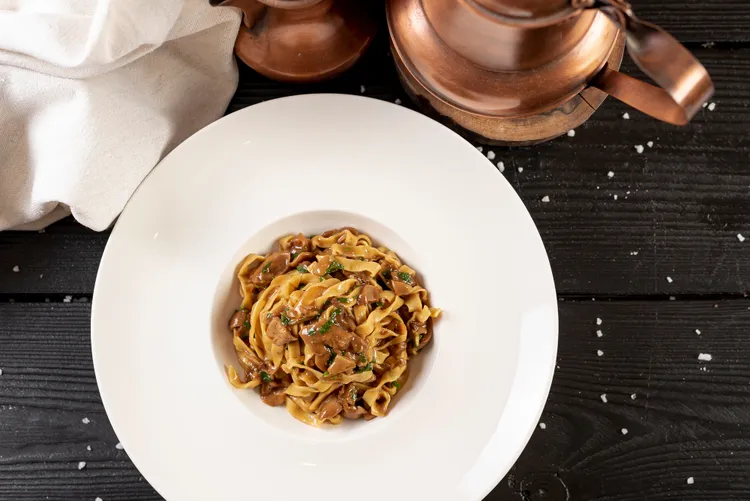
Carbonara is the most technically specific pasta in this collection. It is not a pasta with cream sauce. It is not a pasta with egg and cheese added separately. It is a pasta where the heat of the cooked noodles, the pasta cooking water, and the specific fat content of guanciale (cured pork cheek) are used to emulsify a mixture of egg yolk and Pecorino Romano into a glossy, coating sauce that clings to every strand without scrambling, without breaking, without becoming either too thick or too thin.
The technique is demanding. The margin for error is narrow. And it uses four ingredients - pasta, cured pork, eggs, aged cheese - of which this recipe uses none.
The vegan version therefore has two challenges. First: produce the silky, glossy, coating sauce without eggs or dairy cheese. Second: provide the background richness and the textural contrast that the guanciale provides.
Both are solved. The sauce is built from silken tofu (which, blended, produces a smooth, protein-rich liquid that emulsifies with starchy pasta water exactly as egg yolk does), cashew cream (richness and body), and nutritional yeast (the glutamate depth of Pecorino). The guanciale is replaced by smoked tempeh (its closest equivalent in texture, rendered-fat quality, and savoury depth) or - in the simpler version - pan-fried king oyster mushrooms.
This is the most technically ambitious recipe in this collection. It is worth the effort.
Understanding the Original: What We Are Replicating
Traditional spaghetti alla carbonara is built on a specific emulsification. Egg yolk contains lecithin - an emulsifier that allows fat and water to combine into a stable, glossy sauce. When the egg yolk mixture is tossed with hot pasta and starchy pasta water, the heat partially cooks the yolk proteins (producing thickening) while the lecithin stabilises the fat-water emulsion (producing gloss). The result: a sauce that coats each strand with a thin, glossy, slightly thickened film.
Too much heat and the eggs scramble - the emulsion breaks, producing clumps of cooked egg in oily water. Too little heat and the eggs stay raw - the sauce is thin and uncooked. The correct temperature for carbonara sauce is approximately 63-70°C - hot enough to thicken the proteins, cool enough not to scramble them. This is achieved by removing the pan from direct heat before adding the egg mixture, and using the pasta's residual temperature.
The plant-based solution: Silken tofu contains proteins that behave similarly to egg proteins at heat - they thicken and set within the 63-70°C range. Combined with cashew cream (which provides fat to emulsify into the water phase, in the same role as egg yolk fat and guanciale fat), and nutritional yeast (which provides the glutamate depth of Pecorino), the sauce behaves in the same register as the egg-based original.
The critical variable - as in the original - is temperature management. The sauce should be applied to pasta that is hot but not boiling, with starchy pasta water added gradually to control the consistency.
Ingredients
Serves 4 | Active time: 25 minutes | Total time: 30 minutes
The "Carbonara" Sauce
- 200g silken tofu, drained - the emulsification base
- 100ml cashew cream (thick ratio: 100g soaked cashews blended with 60ml water) - richness and body
- 4 tbsp nutritional yeast - the Pecorino replacement
- 1 tsp white miso - fermented depth
- 1 tsp dijon mustard - sharpness
- 1 clove garlic, minced
- ½ tsp white pepper - traditional in carbonara; more rounded than black pepper in a cream sauce
- Juice of ½ lemon
- Salt to taste
- Reserved pasta cooking water - 200-250ml, hot and starchy (the consistency-adjustment tool)
The "Guanciale" (Choose One)
Option 1 - Smoked tempeh (the best version):
- 200g tempeh, cut into small lardons (1×1×2cm pieces)
- 2 tbsp soy sauce
- 1 tbsp maple syrup
- 1 tsp smoked paprika
- ½ tsp liquid smoke - 3 drops maximum
- 1 tbsp olive oil for frying
Option 2 - King oyster mushrooms (more accessible):
- 250g king oyster mushroom stems, cut into small rounds or lardons
- 2 tbsp soy sauce
- 1 tbsp olive oil
- ½ tsp smoked paprika
Option 3 - Smoked tofu:
- 200g smoked tofu, cut into small cubes
- Pan-fry in olive oil until golden - no additional marinade needed
The Pasta
- 350g dried spaghetti - the traditional shape. Also excellent: rigatoni (which traps the sauce inside the tubes), tagliatelle, or bucatini.
- Generous salt for the pasta water
- Lots of coarsely ground black pepper - freshly ground, for finishing. Carbonara is fundamentally a black pepper pasta.
Method
Step 1: Prepare the "guanciale" (10 minutes)
For smoked tempeh: Combine soy sauce, maple syrup, smoked paprika, and liquid smoke (just 3 drops) in a bowl. Add the tempeh lardons and toss to coat. Marinate for 10 minutes. Heat 1 tbsp of olive oil in a pan over medium-high heat. Fry the tempeh lardons, turning occasionally, for 5-7 minutes until golden and slightly crispy on all surfaces. The maple syrup caramelises into a slightly sticky, slightly charred exterior. Set aside.
For king oyster mushrooms: Heat 1 tbsp of oil in a pan over high heat. Add the mushroom pieces, smoked paprika, and soy sauce. Cook without stirring for 3 minutes until golden on the base, then toss and cook for 2 more minutes. The mushrooms should be golden and slightly chewy. Set aside.
Step 2: Make the sauce (5 minutes)
Blend the silken tofu, cashew cream, nutritional yeast, miso, dijon mustard, garlic, white pepper, and lemon juice until completely smooth - 2 full minutes in a blender. Taste: it should be savoury, slightly sharp, with a specific depth from the nutritional yeast.
The sauce will be very thick at this stage - much thicker than the finished sauce will be. It thins to the correct consistency when starchy pasta water is added in Step 4.
Step 3: Cook the pasta
Bring a large pot of generously salted water to a rolling boil. Add the spaghetti. Cook until 1 minute before the packet's al dente time - the pasta will finish cooking in the residual heat of the sauce.
Reserve 250ml of the pasta cooking water before draining. This water is starchy (from the dissolved pasta surface starch) and hot - both properties are essential for the sauce. Reserve it in a warm jug or bowl.
Drain the pasta. Do not rinse.
Step 4: Emulsify the sauce - the critical step
Turn off the heat completely under the pasta pan. Return the drained pasta to the warm (not hot) pan, off the heat. Add 3 tbsp of the hot pasta water. Toss briefly to cool the pasta slightly - the ideal temperature is hot to the touch but not steaming actively.
Add the sauce: Pour the blended sauce over the pasta. Toss immediately and vigorously, using tongs, lifting the pasta and folding it through the sauce. As you toss, add pasta water one tablespoon at a time - the sauce will thin and become more coating.
The target consistency: The sauce should coat every strand in a glossy, thin film, flowing slightly when the pan is tilted. Not pools of liquid; not a dry coating. Somewhere between - fluid but coating.
If the sauce looks too thick: add more pasta water, one tablespoon at a time, tossing constantly. If the sauce looks too thin: leave for 30 seconds without stirring - the residual heat will thicken it slightly as the proteins set.
Step 5: Add the "guanciale" and serve
Add the prepared tempeh or mushrooms to the pasta. Toss once to combine and distribute.
Serve immediately. Like all carbonara, this pasta continues to thicken as it sits - the proteins in the silken tofu set further as the temperature drops. A carbonara left for 5 minutes becomes gluey; eaten within 90 seconds of finishing it is perfect.
Transfer to warm plates. Add a final generous pour of freshly ground black pepper - this is not optional in carbonara, it is structural. The pepper's heat and aroma are what makes carbonara carbonara.
Offer additional nutritional yeast at the table in place of grated Pecorino.
Troubleshooting
The sauce is scrambled - there are lumps of cooked protein. The pasta was too hot when the sauce was added. Prevent this by cooling the pasta slightly (3 tbsp of pasta water tossed through before adding the sauce) and ensuring the heat is fully off. Recovery: blend the lumpy sauce briefly in a blender with additional pasta water, return to the pasta.
The sauce is too thin and slipping off the pasta. The pasta water concentration was too high or the sauce was too thin to begin with. Increase the cashew cream ratio in the blender. Also: the pasta was not al dente enough, and its surface starch has not fully absorbed - cook 30 seconds less next time.
The sauce tastes flat. More nutritional yeast (up to 5 tbsp total), more white pepper, more salt, and a touch more miso. Taste the sauce from the blender before adding to pasta and adjust at that stage rather than after.
The sauce is gluey and thick. Over-set proteins - either the heat was on too long after adding the sauce, or the pasta sat for too long before eating. Prevention: serve the moment it is done.
Why Silken Tofu Works
The protein in silken tofu - primarily soy protein - behaves differently from the protein in firm tofu. Silken tofu has not been pressed and retains most of its water, producing a smooth, custardy consistency when whole. When blended until completely smooth, it becomes a liquid with a protein concentration similar to egg white - and its proteins set (thicken) within the 63-70°C range, the same temperature at which the egg proteins in traditional carbonara set.
The soy proteins are not identical to egg proteins in their behaviour - they set less dramatically and require slightly more help from the starchy pasta water and the cashew cream fat to produce the same glossy emulsion. This is why the recipe uses all three: silken tofu (protein), cashew cream (fat for emulsification), and pasta water (starch for binding and consistency control).
Pro Tips
- The sauce must be completely smooth. Any graininess from the silken tofu or cashew cream will be apparent in the finished dish. Blend for a full 2 minutes. Strain through a fine-mesh sieve for the smoothest possible result.
- Work fast once the pasta is drained. The window between perfectly al dente pasta and overcooked pasta is 90 seconds. The window between the correct sauce temperature and over-set proteins is similarly narrow. Everything should be ready before the pasta goes in the pot.
- The pasta water is the key variable. Different silken tofus have different protein concentrations; different cashew creams have different thicknesses; different pasta starch levels produce different pasta waters. Adjust with more or less pasta water as needed - the sauce tells you when it's right.
- Pre-warm the plates. Carbonara served on a cold plate drops below the ideal temperature within 60 seconds. Warm plates in a low oven (60°C) or with boiling water while the pasta cooks.
Common Mistake: Using Firm Tofu Instead of Silken Firm tofu blended produces a grainy, slightly gritty sauce that no amount of blending will fully smooth. Silken tofu blends to a completely smooth, pourable liquid in 90 seconds. The distinction matters enormously here. Look for silken tofu specifically - it is sold in vacuum-sealed tetrapacks (Morinaga and Clearspring are common brands) or in water-packed soft form in Asian grocery stores. It is not in the same refrigerated section as firm tofu.
FAQ
Q: Is this really as good as traditional carbonara?
It is a different dish that produces a similar experience. The sauce is glossy and coating in the same way. The black pepper and the savouriness are present in the same way. The specific flavour of egg yolk and Pecorino is not present - the silken tofu and nutritional yeast produce their own character that is in the same register. People who make it without expectations tend to find it genuinely excellent. People who are specifically looking for egg carbonara will find it closely adjacent.
Q: Can I make the sauce ahead?
Yes - blend and refrigerate for up to 2 days. Cold sauce should be brought to room temperature before using (cold sauce added to pasta cools the pasta below the emulsification temperature too quickly).
Q: What is the best pasta shape?
Spaghetti is traditional. Rigatoni is arguably better - the wide tubes trap the sauce inside and produce a more satisfying ratio of sauce to pasta per bite. Tagliatelle and pappardelle work beautifully with the glossy sauce. Any long or tubular pasta works; avoid very small shapes where the sauce-to-pasta ratio becomes too high.
🔗 Continue Cooking
Latest