How to Scale Any Recipe Down to One Serving
The maths, the logic, and the edge cases for reliably halving or quartering any recipe - including what to do with eggs, baking, spice ratios, and cooking times.
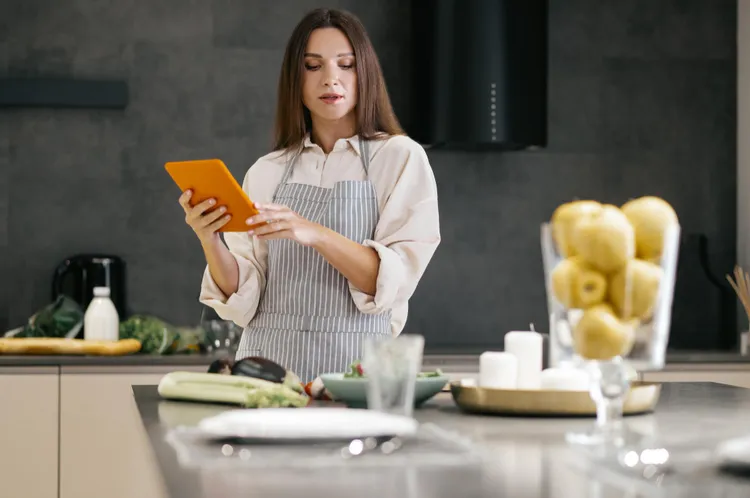
Most ingredients scale linearly. If a recipe serves four and calls for 400g of chicken, you need 100g for one. That part is easy. The complications come from eggs, baking chemistry, spice levels, and the way heat behaves differently with less food in a smaller pan.
The Basic Maths
Divide all quantities by the original serving count to get one portion. A recipe serving four becomes: all quantities divided by four. A recipe serving six: divided by six. Write the original serving count on the recipe before you start if you need to keep referring back to it.
You don't need a calculator for most of this - rough estimates are fine for most savoury cooking. Exactly 87g of onion versus 90g makes no practical difference. The exceptions are baking (precise), spices (test before adding the full scaled amount), and liquids in slow-cooked dishes (covered below).
The Egg Problem
Eggs don't divide. You can't use 0.75 of an egg. The options are:
- Round to the nearest whole egg - one egg instead of 0.75 of one. For most savoury dishes this is fine; the recipe will be slightly richer or slightly more set.
- Use a small egg - medium eggs are measurably smaller than large ones. If a recipe specifies large eggs and you're scaling down, a medium egg is a reasonable substitute.
- Beat and measure - crack a whole egg, beat it, and use a portion by weight. One large egg is roughly 50g without the shell. Scale to what you need, refrigerate the rest and use within a day.
Baking at Small Scale
Baking is the hardest category to scale down. Leavening agents (baking powder, baking soda) don't scale precisely - use slightly less than the calculated amount because residual amounts can affect flavour. Butter and fat often need to be slightly increased in small batches because you lose more to the pan and bowl. Baking times shorten significantly when volume decreases - start checking 20% earlier than the recipe says.
The honest advice for single-serving baking: use recipes designed for single portions rather than scaling down family recipes. Our single-serving baking guide covers mug cakes, small-batch cookies, and one-bowl brownies that are built for one from the start.
Spices and Seasonings
Spice levels don't always scale down proportionally, because your perception of heat and flavour intensity changes with concentration. When scaling a spiced dish down to a quarter, start with a third of the calculated spice quantity and taste as you go. You can always add more; you can't undo a dish that's too hot for the amount of food in the pan.
Salt is the exception - it does scale linearly. Under-salt a small batch and it will taste flat. Add the calculated amount and adjust at the end.
Cooking Times
Less food in a smaller pan cooks faster. As a rough rule:
- Pan-frying one chicken thigh instead of four: same temperature, 2-3 minutes less per side
- Roasting one portion of veg vs a full tray: same temperature, check 10 minutes earlier
- Simmering a sauce scaled to one: reduce heat slightly, it will reduce faster in a smaller pan
- Baking a quarter-batch cake: lower temperature by 10-15°C, check 15-20 minutes earlier
The simplest approach: use the original temperature, start checking 20% earlier than the recipe states, and rely on visual and texture cues rather than time alone.
Liquids in Braises and Slow Dishes
When braising or slow-cooking, don't scale liquids down as aggressively as solids. A braise that calls for 500ml of stock for four chicken thighs doesn't need exactly 125ml for one - you need enough liquid to cover the meat partially and prevent the pan from scorching. 200-250ml is usually enough for one portion even if the strict maths says 125ml.
When Scaling Doesn't Make Sense
Some dishes are structurally designed for volume. A whole roast chicken, a full lasagne, a slow-cooked short rib braise - these are harder to scale to one portion than they are to make as a batch and freeze in portions. For those, the better strategy is to make the full recipe and portion it. Our solo batch cooking guide covers how to turn a large batch into a week of different meals without repetition fatigue.
For the full context of how this fits into cooking for one, see the complete cooking for one guide.
Latest