Roti Canai at Home: Flaky Malaysian Flatbread Without the Skill Gap
Roti canai is the laminated flatbread you see tossed and spun in Malaysian mamak stalls - dough stretched thin, folded over fat, cooked on a hot griddle until blistered and flaky. The technique is learnable at home, and the dough is forgiving.
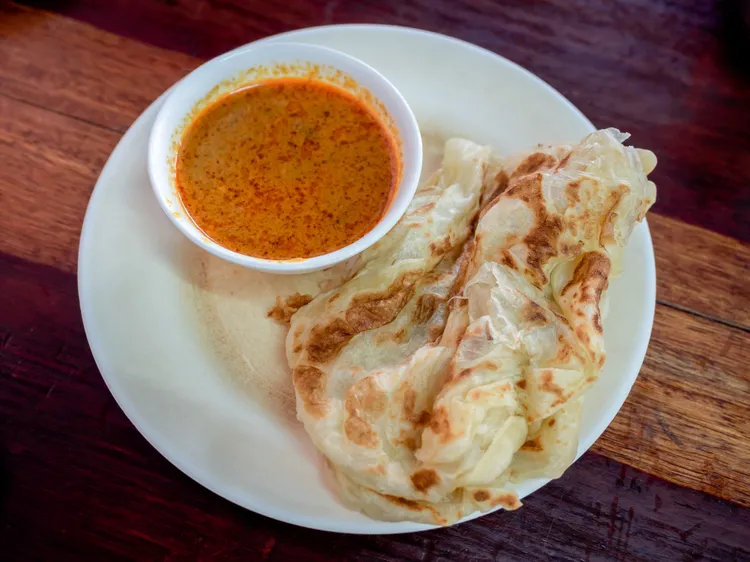
The intimidating part is the spinning - mamak cooks stretch roti canai into translucent sheets through years of repetition. You don't need to do that. A simpler stretch-and-fold method produces the same layers without the theatrics, and the dough's high fat content makes it elastic and easy to work with. The dough needs at least 4 hours to rest - plan ahead or start the night before.
The Dough (makes 8 rotis)
Ingredients
- 500g plain flour (all-purpose), plus extra for dusting
- 1 tsp salt
- 1 tbsp sugar
- 1 egg
- 250ml water, warm
- 3 tbsp condensed milk (or evaporated milk + 1 extra tsp sugar)
- 4 tbsp ghee or butter, softened, for the dough
- Extra ghee or oil for coating and cooking
Making the Dough
- Mix flour, salt, and sugar. Make a well. Add egg, condensed milk, and most of the water. Mix until a shaggy dough forms - add remaining water if needed.
- Knead for 8-10 minutes until smooth. The dough should be soft and slightly sticky but not wet.
- Divide into 8 equal balls. Rub each ball generously with ghee. Place in a greased container, cover, and rest for at least 4 hours at room temperature. Overnight in the fridge (bring to room temp before using) is better.
Shaping and Cooking
- Take one dough ball. On a lightly oiled surface (not floured - oil prevents sticking without toughening the gluten), press it flat with your palm.
- Stretch outward from the centre with your fingertips, rotating as you go, until roughly A4 paper size or larger. It will tear a little. That's fine.
- Dot with a few small pieces of ghee or brush lightly with ghee.
- Fold: bring the top third down, then the bottom third up (like a letter). Then fold the left third over the right. You should have a small square packet.
- Heat a griddle or flat pan over medium-high. No oil needed - the ghee in the dough is enough.
- Cook the folded square for 2-3 minutes per side until golden with dark blistered patches. It should puff slightly.
- Transfer to a board and immediately clap it between your palms a few times - this separates the layers.
Nutrition (per roti, no dipping sauce)
- Calories: ~280 kcal
- Protein: ~6g
- Carbs: ~42g
- Fat: ~9g
What to Serve With It
The classic pairing is dal (lentil curry) and a thin chicken or fish curry for dipping. Leftover kari ayam works perfectly - the thinner sauce is ideal for tearing and dipping. In Malaysian mamak stalls, you also see roti canai served with sugar (roti gula) or banana (roti pisang) as a breakfast option.
Variations
- Roti telur: Crack an egg onto the stretched dough before folding. The egg cooks inside the layers.
- Roti bawang: Scatter thin-sliced onion over the stretched dough before folding.
- Roti pisang: Lay sliced banana across the stretched dough, fold, and cook. Serve with condensed milk.
Meal Prep Notes
Shaped but uncooked roti squares can be stacked with baking paper between them and refrigerated for 2 days, or frozen for up to a month. Cook straight from fridge or frozen on a slightly lower heat. Always cook to order - cooked roti goes leathery. For everything else that roti canai fits alongside in a Malaysian kitchen, see the Malaysian home cooking guide.
Latest