Chawanmushi: Japanese Steamed Egg Custard for Beginners
Chawanmushi is a savoury Japanese steamed egg custard - silky, delicate, full of umami from the dashi base. It comes in at around 120-150 kcal per serving and is more approachable than it looks, once you understand the egg-to-dashi ratio and the steaming technique.
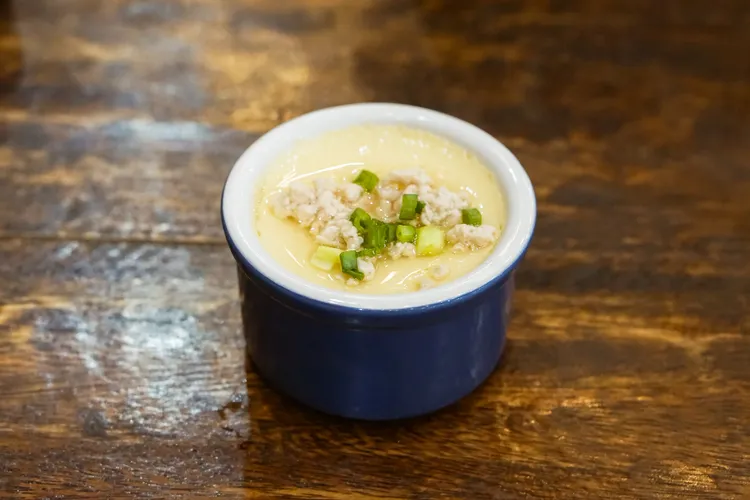
Chawanmushi (literally "steamed in a tea cup") is the Japanese equivalent of a savoury panna cotta - a barely-set, trembling egg custard flavoured with dashi, soy and mirin. It is served hot at Japanese restaurants as a starter or side dish, and in bento boxes at room temperature. The technique is simple: the challenge is getting the egg-to-dashi ratio right and keeping the steaming temperature low enough that the custard sets smoothly without bubbling or developing a pitted surface. Get those two things right and the result is genuinely impressive.
The Ratio
Chawanmushi is all about ratio. The standard Japanese recipe uses approximately 1 egg per 150-180ml dashi. More dashi produces a softer, wobblier custard; less produces something firmer. The recipe below uses 1:160, which sets to a spoonable but not runny consistency.
Ingredients (serves 4, in small cups or ramekins):
- 3 large eggs
- 480ml (2 cups) dashi stock - cold or room temperature
- 1 tablespoon soy sauce (light/shiro soy for colour; regular works)
- 1 tablespoon mirin
- Half teaspoon salt
For the filling (optional but traditional):
- 4 small shrimp, peeled (or small pieces of chicken, fish cake, or crab)
- 4 shiitake mushroom caps, sliced
- 4 ginkgo nuts (optional - traditional, available at Asian grocery shops)
- Mitsuba (Japanese parsley) or spring onion to garnish
Method
Combine eggs, cold dashi, soy sauce, mirin and salt in a bowl. Stir gently with chopsticks or a fork - you want the eggs fully combined but no foam. Strain through a fine-mesh sieve into a clean jug; this removes any unincorporated egg white and gives the custard its smooth finish.
Divide the fillings between the cups. Pour the egg mixture over, filling to about 80% of capacity. Cover each cup tightly with foil or a lid.
Steaming: This is the critical step. Fill a steamer or wok with enough water for 20 minutes of steaming. Bring to a boil, then reduce to medium-low heat. The steam should be gentle, not violent. Place the cups in the steamer. Steam for 13-15 minutes over medium-low heat.
Test for doneness by gently shaking a cup - the custard should jiggle as a single unit, not slosh as liquid. If it still looks liquid in the centre, steam for 2-3 more minutes. If it has pitted or bubbled on the surface, the heat was too high.
Serve immediately, garnished with mitsuba or spring onion. A small amount of ankake sauce (light dashi sauce thickened with cornstarch) can be poured over for an elegant restaurant-style presentation.
Why the Steam Temperature Matters
High-heat steaming causes the egg proteins to contract unevenly, producing holes and a rubbery texture ("su" in Japanese - the term for this defect). Gentle steam at around 90°C / 195°F sets the custard evenly. If your steamer produces very aggressive steam, leave the lid slightly ajar to reduce temperature. This is the single most important variable in chawanmushi.
Variations
- Crab chawanmushi: Fresh or tinned crab as the filling. Add a tablespoon of sake to the egg mixture for extra depth.
- Vegetarian: Use kombu dashi and substitute mushrooms and firm tofu for the protein fillings.
- Truffle: A few drops of truffle oil added to the egg mixture. Modern restaurant version, popular for special occasions.
- Uni (sea urchin): A small amount placed on top after steaming. Rich, oceanic, very Japanese.
Nutrition Estimate (per serving)
- Calories: ~120-150 kcal (with shrimp filling)
- Protein: ~12g
- Carbs: ~4g
- Fat: ~7g
All values are estimates. Chawanmushi is one of the lightest high-protein Japanese dishes - the dashi base keeps calories low while delivering strong umami flavour.
Serving and Storage
Chawanmushi is best eaten immediately. It can be refrigerated and eaten cold or at room temperature within 24 hours - it firms up slightly when chilled, which is acceptable. Do not reheat vigorously; a gentle steam for 3-4 minutes is the best method if you want it warm the next day.
For the full context of chawanmushi within Japanese home cooking, see the complete Japanese cooking guide.
Latest