How to Cook Fish Perfectly Every Time (Without Overcooking It)
Overcooked fish is one of the most common cooking failures in the home kitchen - and one of the most avoidable. The margin for error is about 90 seconds. This guide covers the precise techniques behind crispy-skinned fillets, butter-basted white fish, and everything else worth knowing about cooking fish properly.
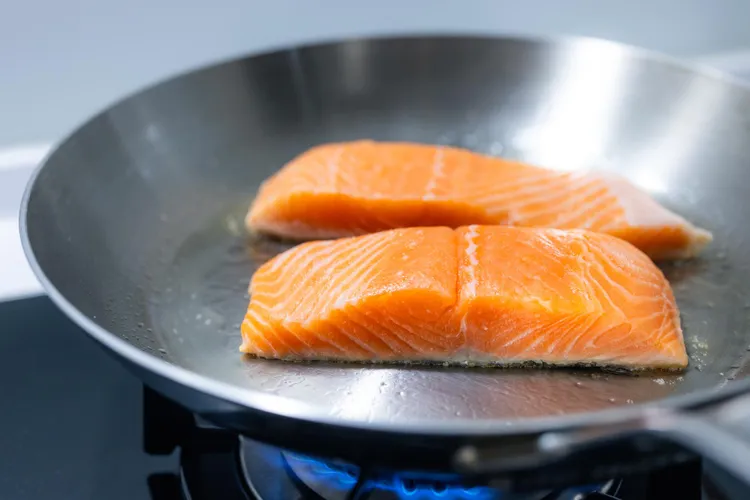
Fish cooks faster than most people expect because the protein structure is fundamentally different from meat. Fish muscle fibres are short and arranged in flakes separated by thin collagen sheets. When heat hits them, those fibres contract and the collagen dissolves almost immediately - the window between perfectly cooked and overcooked is measured in seconds, not minutes. The techniques that work are designed around that reality.
The Skin-Side Down Rule
For skin-on fillets - salmon, sea bass, bream, trout - start in a cold or barely warm pan. This sounds counterintuitive but it's the correct technique: placing skin on very high heat causes it to curl immediately as the protein contracts, lifting the flesh away from the pan and producing uneven cooking. Starting in a cold pan and bringing the heat up gradually keeps the skin flat, develops a slower, more even crisp, and renders the fat out from under the skin progressively.
- Pat skin completely dry. Season the flesh side only with salt and white pepper.
- Add a small amount of neutral oil to a cold pan. Place fillet skin-side down.
- Turn heat to medium-high. Press the fillet gently with a spatula for the first 30 seconds to prevent curling.
- Cook skin-side down for 70-80% of total cooking time. For a 2cm thick salmon fillet, that's about 4 minutes.
- Flip once. Cook flesh-side down for 60-90 seconds. The fish is done when it just begins to flake at the thickest point and has turned opaque roughly two-thirds of the way up.
- Remove from heat. Rest 1-2 minutes before serving.
The skin should be rigid and deeply golden. If it's soft, the pan wasn't hot enough or the skin wasn't dry enough before it went in.
Butter Basting
For delicate white fish - halibut, cod, sole, John Dory - butter basting produces a result that's simultaneously rich and gentle. The technique is used in virtually every high-end fish kitchen.
- Sear the fish presentation-side down in oil over high heat for 60-90 seconds until golden.
- Flip. Reduce to medium. Add 40-50g of butter, 2 crushed garlic cloves, and 3-4 thyme sprigs to the pan.
- As the butter foams, tilt the pan slightly and use a spoon to baste the butter continuously over the top surface of the fish. The butter should be actively foaming throughout - if it browns too fast, reduce the heat.
- Baste for 2-4 minutes depending on thickness. The fish is done when a cake tester or thin knife inserted into the thickest part meets no resistance and comes out warm (not hot - warm means the centre is just cooked).
The butter infused with garlic and thyme becomes an impromptu sauce. Pour it over the fish on the plate.
The Temperature Logic
Salmon is safe and excellent at 50-52°C internal temperature. At this point it's translucent in the very centre and just beginning to flake. Most people cook it to 60°C+, which is where it becomes dry and chalky. If you have a probe thermometer, this single piece of data will change how you cook fish. For other fish: cod and halibut at 55-58°C, tuna at 45-48°C for medium-rare, sea bass at 55°C.
Without a thermometer: press the thickest part of the fillet gently with your finger. Raw fish yields without resistance. Overcooked fish is firm throughout. Perfectly cooked fish has slight resistance at the surface and yields gently at the centre.
Pan Temperature Matters More Than You Think
The most common home cook fish mistake is an insufficiently hot pan - which produces grey, steamed fish rather than golden, seared fish. The pan must be hot enough that the fish sizzles firmly on contact. Test with a drop of water: it should evaporate instantly. If it sputters and sits, the pan needs more time.
Cast iron holds heat better than thin stainless for fish. Non-stick works for delicate fillets but won't achieve the same depth of crust as stainless or cast iron.
Resting
Fish rests. This is ignored almost universally. One to two minutes off heat allows the residual heat to carry cooking through to the centre without the exterior continuing to cook. It also lets the proteins relax slightly, which affects texture. It's a short rest compared to meat, but it matters.
The Three Things That Ruin Fish
In order of frequency: not drying the skin properly (prevents crust formation), moving the fish in the pan (breaks the crust before it forms, causes sticking), and cooking too long (the most common mistake and the least forgivable - there's no fixing overcooked fish).
Fish cooked correctly is one of the simplest expressions of quiet luxury cooking - it requires no complex sauce, no elaborate garnish. Crispy skin, properly seasoned flesh, a spoonful of pan sauce, and something green. The full guide to quiet luxury cooking shows how this technique fits into a broader cooking philosophy built around precision over complexity.
Whole Fish vs Fillets
Everything covered so far applies to fillets. Whole fish have different dynamics: the bone protects the flesh from drying out, cooking times are longer, and the technique shifts to oven-roasting rather than pan-searing for anything larger than a small sea bream. A 500g whole sea bass roasted at 220°C takes 18-20 minutes. The test for doneness: the dorsal fin should pull out cleanly, and a knife inserted into the thickest part (behind the head) should come out warm. The flesh nearest the bone takes longest to cook - this is the temperature to check.
Whole fish on a dinner table has a specific quiet luxury visual quality - especially presented simply with a wedge of lemon, some good oil, and nothing else. The messiness of serving is part of the experience, not a problem to solve.
Poaching as an Alternative to Searing
For very delicate fish - sole, plaice, delicate white-fleshed fish - poaching in a court-bouillon or simple butter poaching produces results that pan-searing can't match. The flesh stays intact, the texture is silky rather than caramelised, and the cooking is entirely gentle and controllable.
Court-bouillon: water, white wine (roughly 1:1), sliced carrot, sliced onion, celery, bay leaf, peppercorns, salt. Bring to a simmer for 15 minutes, then add the fish. Simmer very gently - the liquid should barely move - for 4-8 minutes depending on thickness. Remove with a slotted spatula. Serve with a butter sauce or herb oil.
Butter poaching: melt 200g butter in a wide pan over very low heat - it should liquefy without clarifying. Add the fish to the butter (which should be at around 70°C - not boiling). Cook 8-12 minutes, basting gently, until just set. The result is extraordinarily rich and tender. Used in high-end restaurants for luxury fish like halibut or turbot. The cooking butter becomes a sauce with the addition of lemon juice and fresh herbs.
Buying Fish for Cooking Quality
Freshness determines more about the outcome than technique does. A fresh piece of fish cooked adequately tastes better than a mediocre piece of fish cooked brilliantly. Fresh whole fish: bright eyes (not cloudy), red gills, firm flesh that springs back when pressed, smell of the sea (not fish). Fresh fillets: translucent and moist-looking, no gaps or separation in the flesh, no strong smell. If the flesh looks dull and the edges are drying out, it's not fresh.
Buying from a fishmonger rather than a supermarket pre-packed counter gives you access to fish that was butchered that day rather than packaged two days ago. The price difference is usually modest; the quality difference is significant.
Frozen fish, properly handled (IQF - individually quick frozen - at sea, thawed slowly in the fridge overnight) is often better than "fresh" supermarket fish that's been refrigerated for several days after arriving unfrozen. For salmon and tuna especially, quality frozen fish outperforms mediocre fresh fish consistently.
Fish in the Quiet Luxury Context
Fish is the protein most associated with the quiet luxury aesthetic, partly because the techniques that cook it best - precise heat, basting, resting - are inherently refined. Seared scallops, butter-basted halibut, poached sole: these are dishes that communicate care and skill in a way that braised meat doesn't, even when the braised meat takes ten times as long to cook. The visual quality of a properly seared piece of fish - golden on one side, barely opaque at the centre - is distinctly photogenic in a way that aligns with the quiet luxury plating aesthetic described in the guide to minimalist food plating. For the complete context, the quiet luxury cooking guide shows how fish techniques fit into a broader cooking philosophy.
Specific Fish, Specific Techniques
Different fish benefit from different approaches. Understanding which technique suits which fish is more useful than memorising cooking times.
Salmon: The most forgiving fish to cook at home. Tolerates both pan-searing (for crispy skin) and slow oven-roasting (for silky texture). The cold-pan skin method described above is ideal. Internal temperature target: 50-52°C. Pairs well with butter, miso glazes, and anything acidic.
Sea bass and sea bream: Very similar cooking profile. Skin crisps beautifully and the flesh is delicate. Benefits from high-heat pan searing. Whole fish is excellent at high oven heat. Overcooks quickly - pull at 55°C internal or when the flesh just starts to turn opaque at the thickest point.
Halibut: Dense, thick white fish. Better suited to butter basting than high-heat searing because the thickness means searing over-cooks the exterior before the interior is done. Ideal for oven-roasting at 180°C for 12-15 minutes after a brief pan sear. Rich enough to stand up to assertive sauces.
Cod and pollock: Flaky white fish that breaks apart if moved too much during cooking. Handle minimally - sear in a hot pan, don't touch, flip once, rest. The large flakes are part of the appeal; a cod that stays intact to the plate looks more impressive than one that's been fussed with.
Tuna: The only fish commonly served rare. A tuna steak seared for 60-90 seconds per side should be deep pink in the centre, not grey. Season aggressively with black pepper. The Japanese influence on tuna preparation - sesame-crusted, lightly seared, sliced and served at room temperature - is one of the most compelling quiet luxury fish preparations.
The Resting and Carving of Whole Fish
Whole fish rested for 2-3 minutes before carving is significantly easier to serve than fish carved directly from the oven. The flesh relaxes and the natural separation between the flesh and the spine becomes more pronounced. To carve: run a knife along the spine from head to tail, then slide the knife horizontally under the top fillet to separate it from the bones. Lift off as one piece. Remove the spine by lifting from the tail end. Serve the lower fillet from the board.
The quiet luxury application: whole fish carved tableside, with minimal accompaniment - good oil, lemon, a small dish of aioli or herb sauce - is one of the most impressive yet straightforward things you can put in front of guests. The presentation does the work. For the full context, see the quiet luxury cooking guide.
Accompaniments That Work
Correctly cooked fish needs very little alongside it. The quiet luxury approach to fish accompaniments is the same as its approach to everything else: one or two elements that contrast with the fish in texture or flavour, served with restraint. A properly seared piece of sea bass with a spoonful of pan sauce and a small amount of something green - wilted spinach, roasted courgette, a herb salad - is complete. Adding a starch, a secondary sauce, and a garnish creates a plate that's busier than the fish warrants.
The best accompaniments for fish: lemon (always), good olive oil or butter (one or the other, not both), something slightly bitter or sharp (capers, gherkins, pickled shallots), something green (blanched herbs, a leaf salad, peas). These provide the acid, fat, and freshness that complement fish without overwhelming it. For the seasoning principles that make simple fish preparations taste complete, that guide covers the full framework.
Calculate the macros for your fish dishes with the nutrition calculators.
Latest