How to Scale Any Recipe Up or Down Without Ruining It
Why some ingredients scale linearly with batch size and others don't (salt, leavening, spices), and a practical checklist for doubling, halving, or scaling any recipe correctly.

Doubling a recipe seems like it should be simple multiplication, and for some ingredients it is. For others, doubling everything straight across the board is exactly how a good soup turns bland, a cake turns dense, or a batch of cookies spreads into one giant sheet. Scaling isn't uniform because not every ingredient in a recipe behaves the same way when the batch size changes.
What Scales Linearly and What Doesn't
Some categories of ingredients scale perfectly with batch size, multiply the recipe by 2 and you multiply these by exactly 2:
- Main structural ingredients: flour, meat, the primary vegetable or protein in a dish.
- Fat and sugar in baking, when scaling within a reasonable range (up to about 3-4x).
- Eggs, though only in whole-number increments, which sometimes forces you to round rather than scale exactly (more on that below).
Other categories don't scale linearly at all, and treating them like they do is where most scaling mistakes come from:
- Salt and seasoning: taste perception isn't linear, doubling a recipe rarely means doubling the salt exactly, start at about 1.5x and adjust to taste.
- Leavening (baking powder, baking soda, yeast): scales sublinearly past 2x, doubling leavening exactly in a doubled cake recipe often produces a bitter, over-risen result that collapses.
- Spices and aromatics like garlic, chili, and strong dried spices: their flavor compounds are concentrated enough that linear scaling frequently overwhelms the dish.
- Liquid in baking specifically: evaporation rate doesn't scale with volume, so a doubled batter or dough sometimes needs slightly less liquid relative to flour than pure multiplication suggests.
Why Baking Punishes Scaling Mistakes More Than Cooking Does
Savory cooking, soups, stews, stir-fries, is forgiving because you can taste and adjust as you go. Salt too little, add more. Sauce too thin, reduce it further. Baking doesn't offer that feedback loop, once batter is in the oven, the ratios are locked in, which is exactly why baking recipes are the ones where scaling mistakes actually ruin the result instead of just needing a fix at the table.
This is also why ratio-based thinking (the same logic behind a biscuit's 3:1:2 flour-fat-liquid formula or a muffin's 2:2:1:1 breakdown) matters more for scaling baked goods than savory dishes. If you know the ratio underneath a recipe rather than just the recipe itself, scaling becomes recalculating the ratio at a new total volume, not multiplying a list of ingredients and hoping it holds.
How to Scale Correctly
- Convert to a scaling factor first. Doubling is 2x, tripling is 3x, halving is 0.5x. Multiply every quantity in the recipe by that factor as your starting point, not your final answer.
- Scale structural ingredients exactly. Flour, meat, main vegetables, and fat get the full scaling factor applied without adjustment.
- Scale leavening and salt conservatively. For leavening, use roughly 75-85% of the linear scale-up past 2x (so a 2x batch might use 1.75x baking powder, not a full 2x). For salt, scale to about 1.5x for a doubled recipe, then taste and adjust at the end if the dish allows it.
- Round eggs to the nearest whole number, and adjust liquid slightly to compensate if you rounded down significantly, an extra tablespoon or two of milk or water usually covers the gap.
- Check your equipment before you commit to the scale. A pan, pot, or mixer bowl that's too small for a scaled-up batch changes cooking time, browning, and sometimes safety (a pot that's too full boils over; a pan that's too shallow for a doubled cake batter overflows).
Scaling Down Has Its Own Traps
Halving or thirding a recipe isn't just doubling in reverse, small-batch scaling introduces problems that don't show up going the other direction.
Fractional eggs: One egg halved isn't really possible to measure cleanly. Whisk a whole egg first, then measure out half by volume (about 2 tablespoons), or lean toward using the full egg and slightly reducing another liquid to compensate.
Pan size mismatches: A halved cake batter in a full-sized pan bakes thin and dries out fast. Match pan size to batch size, or adjust bake time down significantly and watch closely rather than trusting the original recipe's timing.
Seasoning gets harder to judge, not easier: Smaller batches are actually more sensitive to seasoning mistakes, a pinch too much salt has a bigger relative impact on a small batch than a large one. Season more conservatively and taste more often when scaling down.
Scaling Yeasted Doughs Specifically
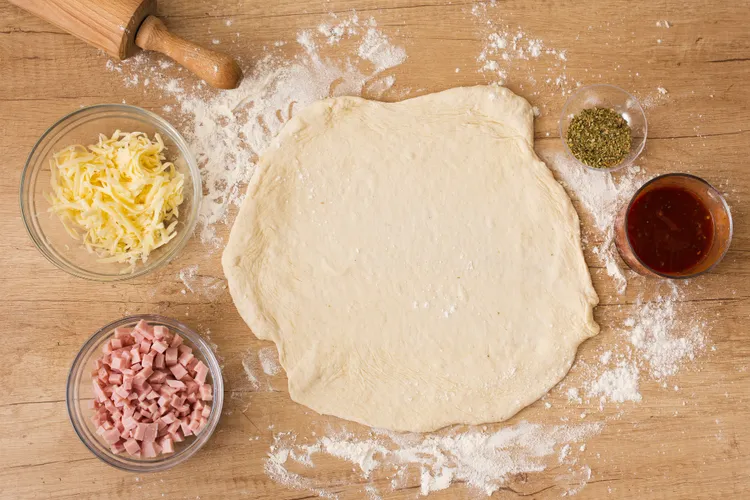
Yeast doesn't scale the way baking powder does. Doubling flour doesn't mean doubling yeast at the same rate, since fermentation time, not just yeast quantity, is what develops flavor and structure. For a doubled batch of dough, scale the yeast by roughly 1.5-1.75x rather than a full 2x, and expect the fermentation time to run close to the original recipe's timing rather than scaling down proportionally just because there's more dough. This is the same principle behind a pizza dough's hydration percentage mattering more than the raw ingredient list, ratios and percentages hold up under scaling in ways flat measurements don't.
A Practical Scaling Checklist
- Structural ingredients (flour, meat, main vegetables): scale exactly by the factor.
- Leavening: scale to roughly 75-85% of the factor past 2x.
- Salt and strong spices: scale to about 1.5x for a doubled recipe, then taste.
- Eggs: round to the nearest whole number, adjust liquid slightly if needed.
- Yeast: scale conservatively (around 1.5-1.75x for doubling) and keep fermentation time close to the original.
- Pan and equipment size: match to the new batch size before you start, not after the batter's already mixed.
Once scaling becomes a question of which ingredients move with the batch and which don't, doubling or halving a recipe stops being a gamble and turns into a predictable adjustment you can make with confidence.
Latest