Muffins Without a Recipe: The 2:2:1:1 Formula
The flour-liquid-egg-fat ratio behind every solid muffin, the two-bowl mixing method that prevents toughness, and fixes for dense, greasy, or flat-topped batches.
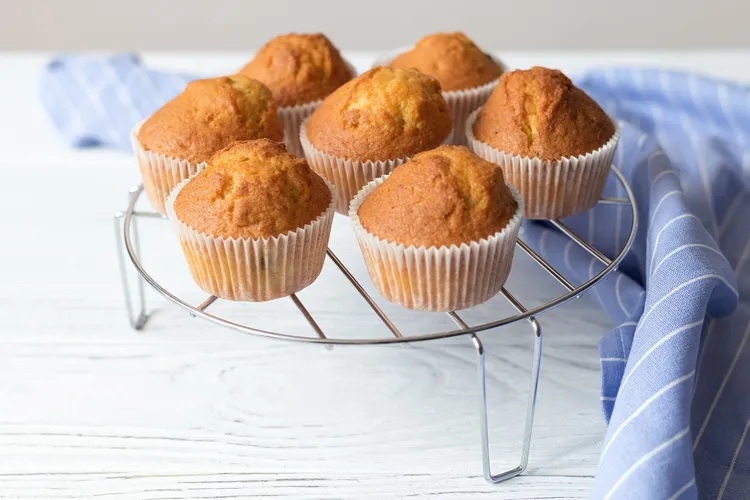
Muffins have a reputation as an easy bake, but most home versions are either dense enough to double as a doorstop or so oily they leave a ring on the paper liner. Neither problem is really about skill. It's about not knowing the ratio that a good muffin is built on, and mixing past the point where it still works.
The Ratio
Every solid muffin, sweet or savory, comes down to the same four-part ratio by weight:
- 2 parts flour
- 2 parts liquid (milk, buttermilk, or a milk-yogurt blend)
- 1 part egg
- 1 part fat (melted butter or neutral oil)
In cups, that's roughly 2 cups flour, 1 cup milk, 2 large eggs, and 1/2 cup melted butter or oil, which makes 12 standard muffins. Add sugar separately, from none for a savory muffin up to 2/3 cup for a bakery-sweet one, since sugar affects flavor and browning but isn't load-bearing for structure the way the other four parts are.
Leavening scales off the flour, not the batch size: 1 tablespoon baking powder per 2 cups flour, plus 1/2 teaspoon salt. That's a stronger ratio than most quick breads use, which is exactly why muffins rise tall and domed instead of flat like a loaf.
Why This Ratio Holds Up Across Every Muffin
Blueberry, bran, cornbread, cheddar-chive, it doesn't matter. The 2:2:1:1 skeleton stays the same, and everything that makes one muffin taste different from another (fruit, spice, cheese, sugar level) gets added on top without disturbing the structure. That's the real value of learning it as a ratio instead of a recipe: you stop needing a different formula for every flavor.
It also explains why substitutions that seem minor can wreck a batch. Swap Greek yogurt for milk without adjusting anything else, and you've effectively increased the liquid's density and protein content, which can make the crumb gummy since yogurt isn't a 1:1 stand-in for milk's water content. If you want to use yogurt, thin it with a splash of milk to bring it back toward the liquid ratio's actual hydration.
The Method
Muffins fail more often from mixing than measuring, so the method matters as much as the ratio itself.
- Whisk the dry ingredients (flour, leavening, salt, sugar) together in one bowl.
- Whisk the wet ingredients (milk, eggs, melted fat) together in a second bowl until just combined.
- Pour the wet into the dry and fold with a spatula, no more than 10 to 12 strokes, stopping while the batter still looks lumpy and slightly streaky.
- Fold in any mix-ins in the last 2 or 3 strokes.
- Divide into a lined or greased 12-cup muffin tin, filling each cup about three-quarters full, and bake at 400°F for 18 to 20 minutes, until a skewer comes out clean.
The two-bowl step isn't fussy, it's what keeps you from overmixing. Combining wet and dry ingredients separately first means the final fold takes far fewer strokes than dumping everything together and stirring until it looks uniform.
The high oven temperature matters too. 400°F gives a fast initial rise that sets the classic domed top before the structure has a chance to spread flat, which is part of why bakery muffins look taller than most homemade ones baked at 350°F.
Troubleshooting by Ratio
Tough, chewy texture: Overmixed. Once wet meets dry, every extra stroke develops gluten. Stop at "mostly combined with visible lumps," not "smooth."
Dense and heavy, doesn't dome: Weak or expired leavening, or too much liquid relative to flour. Check that baking powder is under a year old by dropping a spoonful in hot water, it should fizz immediately.
Flat tops instead of domed: Oven not hot enough, or the batter sat too long before baking. Preheat fully and get the tin in the oven within a few minutes of mixing, the leavening starts working the moment it hits liquid.
Greasy or oily muffins: Too much fat relative to flour, or fat added to a batter that's still warm enough to separate. Let melted butter cool slightly before whisking it into the eggs and milk.
Sunken centers: Underbaked, or the tin was overfilled so the middle couldn't set before the edges. Fill cups no more than three-quarters and check doneness with a skewer rather than trusting the timer alone, since oven temperatures commonly run 15-25°F off their dial setting.
Scaling and Variations
Because the ratio is proportional, doubling for 24 muffins is exact multiplication, no adjustment to leavening percentage needed. Scaling down to 6 muffins works the same way, just watch the bake time, smaller batches in a half-filled tin can finish a couple minutes early.
Swaps that keep the ratio intact:
- Whole wheat flour: Replace up to half the flour by weight before the crumb starts drying out, whole wheat pulls more moisture than white flour absorbs.
- Buttermilk instead of milk: Works at the same volume and adds tang plus a slightly more tender crumb, since the acidity reacts with baking soda if you're using a soda-based leavening blend.
- Savory muffins: Drop the sugar to 1-2 tablespoons (just enough to support browning) and fold in up to 1 cup of shredded cheese, herbs, or cooked vegetables in place of sweet mix-ins.
- Mix-ins generally: Up to 1 to 1.5 cups of berries, chocolate chips, or nuts fold in without changing the structure. Toss fresh or frozen fruit in a spoonful of the dry mix first so it doesn't sink to the bottom of the cup.
Storage
Muffins keep at room temperature in a sealed container for about 3 days, or up to a week refrigerated, though the crumb firms up in the fridge. For longer storage, cool completely and freeze in a single layer before bagging, they'll keep well for up to 3 months and reheat straight from frozen in a 300°F oven for about 10 minutes.
Once the 2:2:1:1 ratio is familiar, "what muffins should I make" stops being a recipe search and starts being a question of what's in the fridge that's worth folding in.
Latest