How to Split 2,000 Calories Across 3 Meals and 2 Snacks
Four ways to divide 2,000 calories across three meals and two snacks, with two sample days and a formula for scaling the split to your own number.
2,000 calories is a total, not a plan. How it divides across the day decides whether you feel steady at 3 pm or end up raiding the cupboard, and there is no single correct split. Most people do well with meals of 500 to 600 kcal and snacks of 150 to 200 kcal, but a night-shift worker, an early-morning trainer and a parent who sits down to dinner at 9 pm each need a different version of the same 2,000. This guide gives you four templates, two worked days with real portions, and a formula to scale the split to any number. If 2,000 is not your number, the Consillar calculators will give you the one that fits your stats and goal, and everything below scales to it.
The Percentage Method
The easiest way to divide any calorie total is by percentage. For three meals and two snacks, a balanced starting point is 25% at breakfast, 7.5% for a morning snack, 30% at lunch, 7.5% for an afternoon snack and 30% at dinner. On 2,000 kcal that comes out to 500, 150, 600, 150 and 600. Round to the nearest 50 and nobody will notice the difference.
That balanced version is the default, but it is not the only option. Here are four templates that all add up to 2,000 kcal, listed as breakfast, snack, lunch, snack, dinner:
- Balanced: 500 / 150 / 600 / 150 / 600. A good fit for a regular daytime schedule with meals at predictable times.
- Front-loaded: 650 / 150 / 600 / 150 / 450. Suits people who are hungriest in the morning, train early, or have long stretches with no food access later in the day.
- Dinner-heavy: 400 / 150 / 500 / 150 / 800. Suits people whose main meal is the social or family one, or who simply want a big evening plate.
- Snack-forward: 400 / 250 / 450 / 250 / 650. Suits people who graze, have long gaps between meals, or find three big meals hard to finish.
None of these is better in any absolute sense. The right one is the one you can follow on a normal Tuesday without thinking about it.
Why Snacks Land Between 150 and 250 kcal
For many people, a snack under 100 kcal does little to bridge the gap between meals, and a snack over 250 kcal starts to behave like a small meal that takes the place of the next real one. The 150 to 250 range gives you enough food to matter without crowding out lunch or dinner. If you rarely want snacks, fold them into the meals instead: 2,000 kcal across three meals is roughly 650 to 700 each, and the same structure applies.
A Sample Day: The Balanced Split
This day follows the balanced template with small tweaks to fit real foods. Cooked weights are used throughout.
Breakfast: ~520 kcal, ~22g protein
- 60g oats cooked in 200ml milk
- 1 banana
- 15g peanut butter stirred in
Morning snack: ~135 kcal, ~16g protein
- 150g plain 0% Greek yogurt
- 100g berries
Lunch: ~570 kcal, ~50g protein
- 120g cooked chicken breast
- 150g cooked rice
- 80g drained canned black beans
- 50g avocado
- 100g salsa and chopped vegetables
Afternoon snack: ~190 kcal, ~13g protein
- 100g low-fat cottage cheese
- 1 pear
Dinner: ~585 kcal, ~42g protein
- 150g baked salmon
- 200g baked potato
- 150g roasted broccoli with 1 tsp olive oil
Day total: about 2,000 kcal and 143g protein.
Notice what carries the day. Lunch and dinner each have a clear protein anchor, a starch and vegetables. Both snacks are built around protein too, which is why the total protein is comfortable even though no single meal is huge. If your protein target is lower, trim the chicken portion at lunch first, since it is the largest single contributor. For a closer look at how protein adds up across a day, see what 150g of protein looks like in a day.
A Plant-Forward Day (Vegetarian)
The same structure works without meat. This version uses eggs, dairy, lentils and tempeh, and lands on the same calories with a different protein total.
Breakfast: ~490 kcal, ~24g protein
- 2 eggs scrambled with 100g spinach in 1 tsp oil
- 2 slices whole wheat toast
- 1 banana
Morning snack: ~165 kcal, ~21g protein
- 200g plain 0% Greek yogurt
- 100g berries
Lunch: ~580 kcal, ~27g protein
- 200g cooked lentils
- 150g cooked quinoa
- 100g roasted vegetables
- 1 tbsp olive oil
Afternoon snack: ~210 kcal, ~7g protein
- 60g hummus
- 150g carrot and cucumber sticks
- 2 rice cakes
Dinner: ~555 kcal, ~37g protein
- 150g tempeh
- 150g cooked brown rice
- 200g stir-fried vegetables in 1 tsp sesame oil
Day total: about 2,000 kcal and 115g protein.
Plant-forward days tend to land lower in protein for the same calories (our vegetarian meal plan for 120g of protein shows how to close that gap), because lentils, quinoa and hummus bring carbs and fat along with their protein. If you want more, the easiest fixes are a second Greek yogurt or a scoop of protein powder in the afternoon snack slot, or swapping the hummus snack for edamame or cottage cheese.
Splitting Protein, Carbs and Fat Across the Day
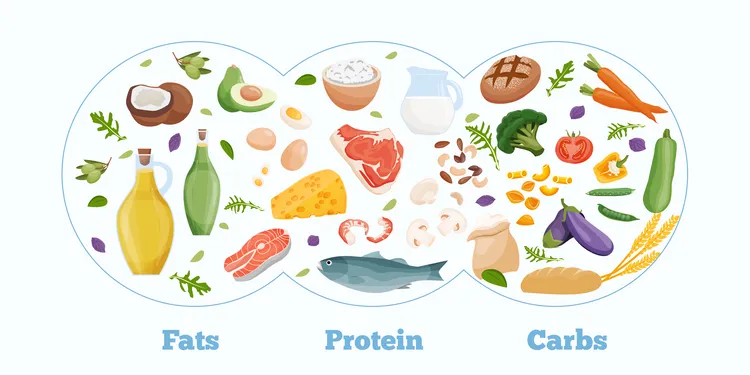
Calories are only half of the picture if you also track macros. The same percentage method works for each macro. As an arithmetic example, take 2,000 kcal at 25% protein, 45% carbs and 30% fat, which is about 125g protein, 225g carbs and 67g fat. Apply the balanced percentages to each number and you get this, rounded:
- Breakfast (500 kcal): about 31g protein, 56g carbs, 17g fat
- Each snack (150 kcal): about 9g protein, 17g carbs, 5g fat
- Lunch and dinner (600 kcal each): about 37g protein, 68g carbs, 20g fat
That is a starting grid, not a rule, and our guide on turning macro targets into a plate shows how to build real meals around it. Your macro split might be 30/40/30, or lower in carbs, or higher in fat. Whatever the ratio, the same trick applies: multiply each macro total by the meal's percentage, and you have targets for every eating occasion. The macro calculator does the first step for you, turning your stats and goal into daily calories and macro grams.
Matching the Split to Your Schedule
If you train in the morning
Many people prefer a lighter breakfast and a larger meal after training, which points to a front-loaded or snack-forward template. Put the snack before the session if you train fasted-feeling and the bigger meal after. The numbers do not change, only the timing.
If you work long shifts with unpredictable breaks
Choose the snack-forward template and pack snacks that need no heating or refrigeration for part of the day: nuts with fruit, protein bars with a label you have actually checked, or a shaker with powder. A larger snack you will certainly eat beats a perfect lunch you will miss.
If dinner is late
When dinner is at 8 or 9 pm, a dinner-heavy split can leave you ravenous at 5 pm. Use the balanced template and make the afternoon snack a full 200 to 250 kcal with real protein in it, so that dinner can stay at 600 rather than ballooning.
If you are not hungry in the morning
Skip the forced big breakfast. Move those calories to the other occasions: 300 at breakfast, 200 for each snack, 550 at lunch and 750 at dinner still adds up to 2,000. The only rule is that the total is right and the day is something you can repeat.
Plate Formulas for 500 to 600 kcal Meals
Once the targets are set, a simple formula builds the plate without a recipe. For a main meal at about 600 kcal:
- Protein: 120 to 150g cooked chicken, fish, lean beef, tofu or tempeh
- Starch: 150 to 200g cooked rice, potato, pasta or quinoa
- Vegetables: 150g or more, any kind
- Fat: 1 tbsp olive oil, or the equivalent in avocado, nuts or dressing
As an example, 130g chicken breast, 175g rice, 150g vegetables and 1 tbsp olive oil is about 615 kcal. For a 500 kcal breakfast, shrink the starch and fat slightly. For a 400 kcal one, halve the starch and keep the protein. The proportions hold, only the size changes.
Snack Ideas at 150 to 250 kcal
Approximate calories, so you can mix and match without a scale every time:
- 150g plain 0% Greek yogurt with 100g berries: about 135 kcal
- 2 hard-boiled eggs: about 140 kcal
- 60g hummus with raw vegetable sticks: about 140 kcal
- 1 apple with 15g almonds: about 180 kcal
- 100g low-fat cottage cheese with a pear: about 190 kcal
- 1 banana with 1 tbsp peanut butter: about 200 kcal
- 1 scoop whey in 200ml milk: about 215 kcal
Prepare two or three of these as a standing rotation. Deciding what to eat at 4 pm is where most snack plans fail, so remove the decision.
Where the Split Usually Breaks
- Cooking fats: One tablespoon of olive oil is 120 kcal. Three tablespoons across a day's cooking is more than a snack, and most people forget to count it.
- Liquid calories: Flavored coffee drinks, juice and smoothies can add 200 to 400 kcal without feeling like a meal. Count them as an eating occasion or cut them.
- Snack creep: A handful of nuts is about 30g, which is roughly 175 kcal. A "quick bite" of granola or trail mix can be double that. Weigh them a few times to learn what the portion looks like.
- Weekends: A split that works Monday to Friday often collapses on Saturday. Decide in advance which template you will use on days off.
- Borrowing from tomorrow: Skipping a snack and eating a bigger dinner is fine. Skipping several and eating everything at night is how a 2,000 kcal plan turns into 2,600.
How to Tell If a Split Is Working
Run a template for a full week before judging it, and ask three plain questions. Are you hungry at the same predictable times, or all over the place? Do you have steady energy between meals, or a slump at a specific hour? Can you actually finish each portion without forcing it? A slump at 3 pm usually means the lunch or the afternoon snack is too small, or short on protein. Constant evening hunger usually means the day is underfed before dinner. Fix one thing at a time by moving 50 to 100 kcal from one slot to another, and give the change a few days. The total stays at 2,000, and only the shape of the day changes.
Prep the Split in Advance
A split is easiest to follow when the portions already exist. One session on the weekend can cover most of the week. Cook a large batch of protein and one or two starches, roast a tray of vegetables, and portion everything into containers sized to your lunch and dinner targets. For five lunches at 600 kcal, for example, that means roughly 650g of cooked chicken, 875g of cooked rice and 750g of vegetables, with the oil measured per container rather than poured freely. Snacks can be portioned the same way: five tubs of yogurt and berries, five bags of almonds at 15g each.
Cooked chicken, rice and vegetables keep for 3 to 4 days in the fridge. Cool them within 2 hours of cooking, and freeze anything you will not eat in that window in single portions. If you want help turning your targets into actual meals, the Consillar meal planner builds a day around your numbers, and the meal prep tool scales the batch for the whole week.
Scaling the Split to Another Number
The percentages work at any calorie level. Using the balanced template, here is how the same five occasions look at other totals, listed as breakfast, snack, lunch, snack, dinner:
- 1,600 kcal: 400 / 120 / 480 / 120 / 480
- 1,800 kcal: 450 / 135 / 540 / 135 / 540
- 2,200 kcal: 550 / 165 / 660 / 165 / 660
- 2,500 kcal: 625 / 190 / 750 / 185 / 750
When you scale down, reduce starches and added fats first and keep the protein anchors in each meal. When you scale up, add carbs and fats to the same structure. Protein rarely needs to change as much as the rest of the plate, which is why a 1,600 kcal day and a 2,500 kcal day can both use the same chicken, fish or tofu portions.
A Note on These Numbers
All figures here are estimates based on typical cooked weights and common nutrition databases. Brands, cuts and cooking methods shift them by 10% or more, so use them as a planning guide rather than exact values. This is general food information, not medical or dietary advice. If you have a medical condition or follow a medically supervised diet, talk to a qualified professional before changing how you eat.
Latest