How to Tell When Food Is Done: Temperatures and Visual Cues
Stop guessing. Learn the exact temperatures and the color, texture and touch cues that show when meat, fish, eggs, baked goods and vegetables are truly done.
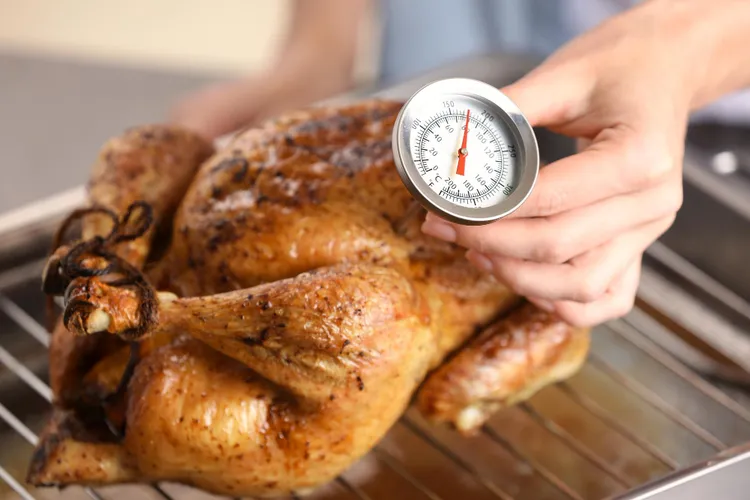
Color is one of the least reliable ways to judge whether food is cooked. Ground beef can turn brown before it is safe, and chicken or pork can stay pink after it is. Cooks who rely on color end up with dry chicken, gray steak or an undercooked center, and the fix costs less than a lunch out: a thermometer, plus a handful of visual and touch cues for the foods a thermometer cannot reach.
How to Use a Thermometer Correctly
An instant-read digital thermometer gives a reading in 2 to 4 seconds. Most bad readings come from using it wrong, not from a bad device.
- Aim for the thickest part. That is the last place to heat up, so it is the coldest spot and the one that matters.
- Stay away from bone, fat and the pan. Bone conducts heat and reads too high. Fat and a hot pan do the same.
- Insert at least ½ inch (1.5 cm). The sensor sits near the tip, and a shallow probe reads the surface. Dial thermometers need about 2 inches (5 cm).
- Go in sideways for thin cuts. For a burger or a thin chop, push the probe in from the side so the tip sits in the center.
- Check two or three spots. Large or uneven foods heat unevenly.
- Wait for the number to stop moving. Then clean the probe before checking again.
To check accuracy, stir a glass of ice and water for 30 seconds and insert the probe. It should read 32°F (0°C), give or take 2°F. Boiling water reads 212°F (100°C) at sea level, and about 1°F lower for every 500 ft of altitude. An infrared "laser" thermometer only reads the surface, so it cannot tell you whether the inside is done.
Carryover Cooking: Pull Early
Food keeps cooking after it leaves the heat, because the hot outside keeps pushing heat toward the center. Take it off before the target and the rest finishes the job during resting.
- Thin or small cuts (steaks, chops, chicken breasts): expect a rise of about 3 to 5°F (2 to 3°C)
- Thick roasts and whole birds: expect 5 to 10°F (3 to 6°C), sometimes more at high oven temperatures
- Fish and shrimp: small rise, but they go from perfect to dry in under a minute, so stop early
Beef and Lamb
These are final temperatures after resting. Pull the meat about 5°F (3°C) earlier.
- Rare: 120 to 125°F (49 to 52°C). Cool red center, very soft
- Medium-rare: 130 to 135°F (54 to 57°C). Warm red center, juicy and tender
- Medium: 140 to 145°F (60 to 63°C). Pink center, firmer
- Medium-well: 150 to 155°F (66 to 68°C). Slight pink, dry edges
- Well-done: 160°F (71°C) and above. No pink, much firmer
The USDA's minimum for whole cuts is 145°F (63°C) followed by a 3-minute rest. Cooking steak below that is a personal risk choice, and it applies only to whole cuts, never to ground meat. Children, pregnant people, older adults and anyone with a weakened immune system should stick to the USDA numbers.
Ground beef and lamb should reach 160°F (71°C), because grinding spreads surface bacteria through the meat. Do not judge burgers by color. Burgers can look done at 135°F and stay pink at 160°F.
The Palm Test: Useful, Not Exact
Touch your thumb to each fingertip in turn and press the fleshy pad below your thumb. Index finger feels like rare, middle finger medium-rare, ring finger medium, little finger well-done. The method is rough, because muscle thickness varies from hand to hand and cut to cut. Use it to learn what firmness feels like, and check against the thermometer a few times until you trust your own hand.
Pork
- Chops, tenderloin, loin roast: 145°F (63°C), then rest 3 minutes. A slightly pink center at this temperature is safe and juicier than the gray pork of old advice
- Ground pork and sausage: 160°F (71°C)
- Pulled pork (shoulder): 195 to 205°F (90 to 96°C). Safe much earlier, but connective tissue only turns tender at this range. The cue is a probe sliding in with almost no resistance
- Fully cooked ham, reheated: 140°F (60°C)
Chicken and Turkey
Poultry is safe at 165°F (74°C) in the thickest part, but different cuts taste best at different points.
- Breasts: pull at 160 to 162°F (71 to 72°C). Carryover brings it to 165°F during a 5-minute rest. Going to 175°F makes breast dry and stringy
- Thighs and drumsticks: safe at 165°F, but better at 175 to 185°F (80 to 85°C). Dark meat has more connective tissue and turns juicier and more tender with extra heat
- Whole bird: insert the probe in the thickest part of the thigh, near but not touching the bone, and check the thickest part of the breast too. Both need to reach 165°F
- Ground poultry: 165°F (74°C)
Visual cues help but do not replace the probe. Juices run clear and the meat feels firm but springs back. Pink near the bone does not always mean unsafe, and clear juices do not always mean safe. When the thermometer and your eyes disagree, believe the thermometer.
Fish and Seafood
The USDA minimum for fish is 145°F (63°C). Many cooks prefer salmon at 125 to 130°F (52 to 54°C) for a moist, tender center, which is below that minimum. Stick to 145°F for pregnant people, young children, older adults and anyone with a weakened immune system.
- Fork test: insert a fork at an angle and twist gently. The flesh should separate into flakes and look opaque. A glassy, translucent center means it is still raw inside
- Salmon: white protein oozing out on the surface (albumin) is a sign of overcooking
- Cod and other white fish: opaque all the way through, flaking with light pressure. Plan on 135 to 145°F (57 to 63°C)
- Shrimp: pink and opaque, curled into a loose C. A tight O means overcooked
- Scallops: opaque, firm with a slight give when pressed. Rubbery means overcooked
- Mussels and clams: done when the shells open. Discard any that stay closed after cooking
Eggs and Custards
- Fried and poached eggs: the white is fully opaque with no clear, wobbly liquid. The yolk should jiggle slightly if you want it runny
- Scrambled eggs: remove them while still slightly glossy and wet. They firm up on the plate
- Quiche, frittata and egg casseroles: 160°F (71°C) in the center, with set edges. A knife inserted in the middle comes out clean
- Baked custard and cheesecake: the edges are set, and the center wobbles like gelatin when you nudge the pan. The center reads about 150°F (65°C), and it firms up as it cools
Baked Goods
Baking fails more from pulling too early or too late than from bad recipes. Use several cues, not just a timer.
- Cakes and muffins: a toothpick or skewer comes out clean or with a few dry crumbs. The top springs back when lightly pressed, and the edges start to pull from the pan. Internal temperature: 200 to 210°F (93 to 99°C)
- Lean bread (baguette, sourdough): 205 to 210°F (96 to 99°C), a deep golden crust and a hollow sound when you tap the bottom
- Enriched bread (sandwich loaf, brioche, rolls): 190 to 195°F (88 to 91°C). Eggs, milk and butter make them brown early, so tent with foil if the top darkens first
- Brownies: a toothpick should come out with a few moist crumbs, not wet batter. The edges are set and the center barely jiggles. They finish setting as they cool
- Cookies: pull them when the edges are set and golden but the centers still look slightly underdone. They firm up on the tray for 5 minutes
- Fruit pie: thick bubbles breaking slowly through the vents, and a deep golden crust, not pale
Vegetables
Vegetables have no safe-temperature rule, so doneness is about texture and color. The target changes by dish, from crisp-tender to fully soft.
- Potatoes and root vegetables: a knife or fork slides in with little resistance. Roasted ones have deep golden, crisp edges
- Broccoli and green beans: bright green and fork-tender with a slight bite. Dull olive color means overcooked
- Asparagus: bright green, and bends slightly when you lift a spear without going limp
- Carrots: a fork slips in with slight resistance, and roasted edges are browned
- Brussels sprouts and cauliflower: deeply browned on the cut side and tender in the center
- Mushrooms: they release water first. Done when that water has cooked off and they are golden-brown
- Onions: translucent and soft at 5 to 8 minutes, golden at 15 to 20, deep brown and jammy at 35 to 45 minutes over low heat
- Garlic: pale gold after about 30 seconds. Brown garlic is bitter, so add it late
- Leafy greens: done as soon as they wilt, within 1 to 2 minutes for spinach
Pasta, Rice and Beans
- Pasta, al dente: bite a piece and look at the cross-section. A tiny pale dot or thin lighter ring in the center means it is just right. Fully uniform color means it is soft
- Rice: small steam holes appear on the surface when the water is absorbed. Grains are tender, separate easily and have no crunch in the center. Rest it covered for 10 minutes before fluffing
- Lentils: tender with a slight bite, holding their shape. Red lentils are done when they collapse into a thick puree
- Beans and chickpeas: the skin stays mostly intact, the inside is creamy, and a bean mashes easily between two fingers. A chalky center means more time
Sauces, Oil and Pans
Some doneness cues are about the cooking surface and the sauce, not the food.
- Sauce thick enough: dip a spoon, then draw a finger across the back. If the line stays clean, the sauce coats the spoon and is ready
- Pan hot enough (oil): oil shimmers and flows like water. Thin wisps of smoke mean it is too hot
- Pan hot enough (stainless steel): a drop of water beads up and glides across the surface instead of sizzling and vanishing
- Deep-frying oil: 350 to 375°F (175 to 190°C). A cube of bread browns in about 1 minute at 350°F
- Caramel: pale straw for sweet and mild, amber for balanced, dark amber for bitter. Watch it constantly, because it goes from amber to burnt in seconds
Common Thermometer Mistakes
- Probing too early and too often. Opening the oven repeatedly drops the temperature. Check once near the end of the expected time
- Hitting bone. It reads high and gives false confidence. Pull back until the tip is in meat only
- Ignoring carryover. Pulling at the final target gives you the overcooked version
- Skipping the rest. Cutting in right away spills the juices you just worked to keep
- Using the same unwashed probe. Wash it after touching raw meat so it does not spread bacteria to cooked food
Quick Reference: When to Pull
- Steak, medium-rare: pull at 125 to 130°F, final 130 to 135°F
- Chicken breast: pull at 160 to 162°F, final 165°F
- Chicken thighs: pull at 175 to 180°F
- Pork chops and tenderloin: pull at 140°F, final 145°F
- Salmon (USDA): pull at 140°F, final 145°F
- Ground meat: 160°F (poultry 165°F)
- Large roasts: pull 5 to 10°F below the target
- Cake and muffins: 200 to 210°F
- Lean bread: 205 to 210°F
Common Questions
Is a meat thermometer worth buying?
Yes. It prevents dry chicken, overcooked roasts and undercooked centers, and it works for bread and custard too. A basic instant-read digital model does the job.
Why is my chicken still pink at 165°F?
Pink can come from the bird's age, the cooking method or a chemical reaction with the cooking environment. It does not mean the meat is unsafe at 165°F. Trust the number over the color.
What if I do not own a thermometer?
Combine cues. Use time as a guide, cut into the thickest part and check that the juices run clear and the center is opaque, and rest the meat before serving. This works better for chicken and fish than for steak or ground meat, where color misleads. For pork, poultry and ground meat, a thermometer is the safer choice.
Does doneness change calories and macros?
Slightly. The longer meat cooks, the more water it loses, so 100 g of well-done steak holds more calories and protein than 100 g of medium-rare. If you track macros, weigh the food raw so the numbers stay consistent, whatever doneness you choose.
Should I rest all meat?
Yes. Rest steaks and chicken breasts for 5 minutes, and roasts and whole birds for 15 to 20 minutes. Tent loosely with foil so the crust does not steam.
Use the thermometer for meat, poultry and fish, use texture and color cues for vegetables, grains and baked goods, and pull food a few degrees before the target so carryover cooking finishes the job. Bookmark this page for the next time the pan is hot and you are not sure it is done.
Latest