Crystallised Ginger: Slow Method and Quick Method
Homemade crystallised ginger has genuine heat and complexity that commercial versions lack. This guide covers both the slow traditional method and a quick version ready in under two hours.
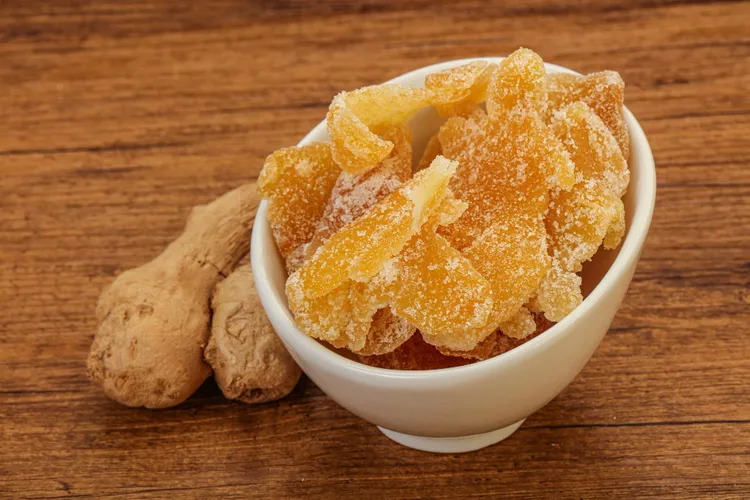
Commercial crystallised ginger is mild, sugary, and barely registers as ginger. Homemade crystallised ginger is a different product entirely: fiery from the fresh root, complex from the blanching and candying process, and with a chewiness that holds its own against strong flavours in baking. The ginger syrup left over from the process is itself a valuable ingredient.
Choosing Ginger Root
Young ginger (pale skin, minimal fibre, available from specialist grocers and some Asian supermarkets) produces the most tender crystallised ginger with less chewiness and milder heat. Mature ginger (the brown-skinned root found in any supermarket) has more heat and more fibre - the finished product is chewier and more intensely flavoured. Both are correct; the choice depends on preference. Whichever you use, select pieces with smooth skin and no soft spots. The root should be firm and snap cleanly rather than bending.
Slow Method: Traditional Seven-Day Crystallised Ginger
The slow method produces the finest result: deep candy penetration, more translucent appearance, and a more complex flavour from the gradual sugar exchange. Active time is about 10 minutes per day for seven days. Most of the time is waiting.
Makes: approximately 250g | Active time: 10 minutes per day for 7 days
Ingredients (Slow Method)
- 300g fresh ginger root, peeled
- 600g white granulated sugar, divided
- 500ml water
- Extra sugar for rolling
Instructions (Slow Method)
- Day 1: Slice ginger into rounds 4 to 5mm thick. Place in a saucepan with cold water. Bring to a boil and simmer for 20 to 30 minutes until tender when pierced with a skewer. Drain. Combine 200g of the sugar with 500ml water in the pan. Heat to dissolve. Add ginger. Simmer 10 minutes. Remove from heat. Transfer to a bowl, cover, and leave 24 hours.
- Days 2 to 6: Each day, drain the syrup into a saucepan. Add 50g of sugar. Heat to dissolve. Add ginger. Simmer 5 minutes. Remove from heat. Cover and leave 24 hours.
- Day 7: Drain ginger from syrup (reserve the syrup). Spread on a wire rack. Leave at room temperature for 2 to 3 hours until surface is slightly tacky. Roll each piece in granulated sugar. Return to the rack and leave until the sugar coating is dry (4 to 6 hours). Store in an airtight jar at room temperature for 6 months.
Quick Method: Two-Hour Crystallised Ginger
The quick method uses a single concentrated syrup and produces a very good result in an afternoon. Less translucent than the slow version, but the flavour is excellent.
Makes: approximately 200g | Prep: 15 minutes | Cook: 50 minutes | Dry: 2 to 3 hours
Ingredients (Quick Method)
- 250g fresh ginger root, peeled and sliced 4mm thick
- 400g white granulated sugar
- 300ml water
- Extra sugar for rolling
Instructions (Quick Method)
- Simmer ginger slices in water for 25 minutes until just tender. Drain.
- Combine sugar with 300ml fresh water. Bring to a boil, stirring to dissolve. Add ginger. Simmer over low heat for 20 to 25 minutes, stirring occasionally, until slices are translucent and syrup is very thick.
- Lift ginger from syrup with a slotted spoon. Toss immediately in granulated sugar while still warm. Spread on a wire rack and dry for 2 to 3 hours. Store in an airtight jar.
The Ginger Syrup
Both methods leave behind a ginger-infused sugar syrup that should not be discarded. It keeps in a sealed jar in the fridge for 3 months. Uses: stirred into hot water for ginger tea, added to cocktails and mocktails, used in place of simple syrup in baking, drizzled over ice cream, used in the simple syrup guide for making a ginger-flavoured drink syrup.
Uses for Crystallised Ginger
Chopped into flapjacks, ginger cake, and fruit cake. Pressed onto the surface of shortbread before baking. Dipped in dark chocolate and left to set. Chopped finely and folded into whipped cream for a quick dessert. Served alongside cheese, particularly aged cheddar and blue cheeses. Eaten on its own as a confectionery between courses. The heat of the ginger clears the palate and acts as a digestive - this is its traditional role in many Asian culinary traditions.
Nutrition (per 30g)
- Calories: approximately 95 kcal
- Carbs: 25g (of which sugars 24g)
- Protein: 0g
- Fat: 0g
For the complete guide to sugar preserving techniques, see the complete sugar preserving guide.
Ginger Varieties and Their Impact
The variety and age of the ginger root makes a significant difference to the finished crystallised ginger. Young ginger (available from spring through early summer, with thin, almost translucent skin and minimal fibre) is milder, more tender, and produces a more delicate result. It is preferred by many confectioners for this reason. Mature ginger (the standard supermarket root available year-round) has more heat, more phenolic compounds, and a more pronounced flavour. It is also more fibrous, which means the slices retain more chew after candying.
For culinary purposes - chopping into cakes, flapjacks, and biscuits - the texture difference is irrelevant and mature ginger's stronger flavour is often preferable. For eating as a confectionery item, young ginger's tenderness is worth seeking out. Most Asian grocery shops and specialist food retailers carry young ginger during its season.
Ginger and Digestive Health
Crystallised ginger has a traditional role in settling the stomach and managing nausea. The active compound in ginger (gingerol, and its cooked form shogaol) has genuine anti-emetic properties supported by clinical research. Crystallised ginger is commonly recommended during pregnancy for morning sickness and during travel for motion sickness. The sugar coating makes it a more palatable delivery mechanism than raw ginger or ginger capsules for people who find the raw root too intense. A small jar of homemade crystallised ginger is a thoughtful and genuinely useful gift for anyone in these situations. For gifting presentation, see the sugar preserves gift guide. For the full sugar preserving overview, see the complete sugar preserving guide.
Crystallised Ginger in Savoury Cooking
Beyond the obvious sweet applications in baking and confectionery, crystallised ginger works in a number of savoury contexts. Finely chopped and scattered over a duck breast or pork belly in the last 10 minutes of roasting, it caramelises and provides a sweet-spiced crust. Stirred into a dressing for a salad of mango, avocado, and prawns, it adds heat and sweetness. A small piece of crystallised ginger alongside a piece of aged cheese - particularly a firm goat cheese or a mild blue - is an excellent combination that most people have not encountered.
The ginger syrup left over from production is particularly useful in savoury applications: a tablespoon in a marinade for chicken or pork, a teaspoon in a stir-fry sauce, added to a vinaigrette for an Asian-inflected salad dressing. The syrup has the ginger heat without the crystallised texture, which makes it more versatile across cooking contexts. For the complete guide to sugar preserving including the full range of techniques from candied fruit to syrups, see the complete sugar preserving guide. Use Consillar's meal prep planner to schedule seasonal preserving projects including a ginger session in summer when fresh young root is at its best.
Building a Ginger Preserve Session
A productive ginger session produces three products simultaneously from one batch of fresh root: crystallised ginger slices from the firm centre sections, ginger syrup from the cooking liquid, and any small trimmings or irregular pieces finely chopped and frozen for use in cooking. This zero-waste approach means that a 300g piece of fresh ginger root produces approximately 200g of crystallised ginger, 250ml of flavoured syrup, and 50g of finely chopped frozen ginger. All three have different applications and all three are more useful than the raw root.
Plan the session for a Sunday when the slow method has been running for seven days, or a Saturday afternoon for the quick method. Set up a cooling rack over a baking tray before starting the session so the ginger can go straight from the syrup onto the rack. Have the rolling sugar ready in a wide, shallow bowl. Keep the empty syrup saucepan for bottling the remaining syrup immediately after the ginger is removed - the residual heat helps bottle it cleanly. For the complete sugar preserving guide covering the full range of techniques, see the complete sugar preserving guide. Use Consillar's meal prep planner to schedule a ginger preserving session when fresh young root is available in summer.
Ginger Syrup Uses
The syrup produced during crystallised ginger making - whether using the slow or quick method - is a concentrated ginger-flavoured sugar syrup with genuine heat and complexity. It keeps in the fridge for 6 to 8 weeks in a sealed bottle. Uses: stirred into hot water for a fast ginger tea, added to cocktails and mocktails (a tablespoon in sparkling water with lime is an excellent non-alcoholic ginger drink), used in ginger cake batter in place of part of the sugar for a more intense ginger flavour, drizzled over ice cream or yoghurt, used as a glaze for grilled chicken or pork where sweet-spiced glazes work well. The syrup that comes from the slow seven-day method is particularly dark and intensely flavoured - some home cooks make the slow method specifically for the syrup and treat the crystallised ginger as a by-product rather than the primary goal. For the complete sugar preserving guide, see the complete sugar preserving guide. Use Consillar's nutrition calculators to track ginger syrup in your diet.
Comparing Slow and Quick Methods: Which to Choose
The slow seven-day method and the quick two-hour method produce different products. The slow method gives more translucent, more deeply candied ginger with a cleaner flavour and a slightly more yielding texture. The sugar has penetrated fully to the centre of each slice and the volatile aromatic compounds have had time to develop through the gradual process. The quick method produces a good result - sweet, with real ginger heat, properly crystallised on the outside - but the interior remains slightly more fibrous and the flavour is less refined.
For eating as a confectionery and for gifting, the slow method is worth the seven days. For use chopped in baking, where the texture difference is lost in the mixing and baking process, the quick method is entirely adequate and saves six days. A practical approach: make the slow method in summer when young ginger is available and the flavour investment is most rewarded. Make the quick method in autumn when demand for crystallised ginger in baking is higher and the faster turnover is more useful. Both methods use the same ingredients and produce the same ginger syrup as a by-product. For the complete sugar preserving guide and all techniques, see the complete sugar preserving guide.
Notes on Slicing Thickness
The 4 to 5mm thickness specified in both recipes is optimal for most applications. Thinner slices (2 to 3mm) candy faster - the quick method works in 30 to 35 minutes rather than 45 - and produce a more delicate, crisper result that works better as a dessert garnish or in fine confectionery. Thicker slices (6 to 8mm) need longer cooking time in the syrup - add 15 minutes for the quick method - and produce a chewier, more substantial result that is better for eating as a standalone confectionery and for chopping into flapjacks and dense cakes where the ginger pieces should register in the texture of the finished bake. Consistency of thickness within a batch matters more than the exact thickness chosen - uneven slices cook at different rates and some will be over-crystallised while others are under-done. A mandoline slicer set to the desired thickness produces the most consistent results. Use Consillar's nutrition calculators to track crystallised ginger in your daily intake. For the complete guide to all sugar preserving techniques, see the complete sugar preserving guide.
Both methods produce a preserve worth making regularly. The slow method rewards patience with a superior product suited to gifting and confectionery. The quick method rewards efficiency with a very good product suited to immediate baking needs. Choose based on what you need the ginger for and how much time you have. For the complete guide to all sugar preserving techniques in this series, see the complete sugar preserving guide.
Latest