Sugar-Preserved Flowers and Rose Petals
Crystallised flowers and sugar-preserved rose petals are purely decorative but exactly the right decoration for certain cakes and desserts. Here is how to make them properly.
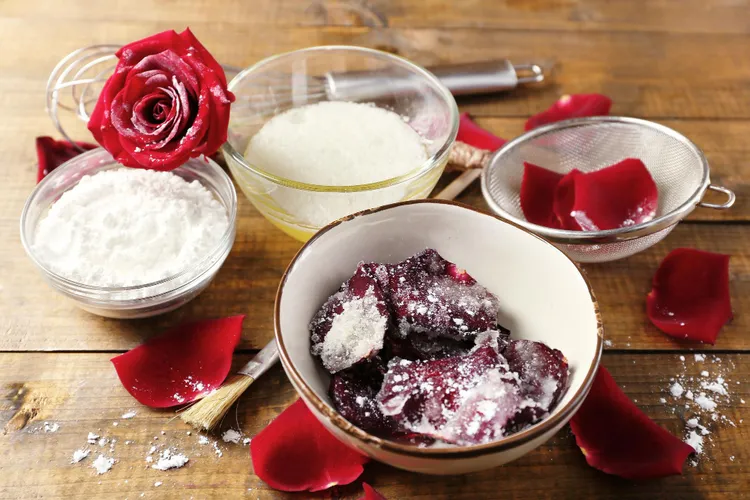
A crystallised violet on a cake, a sugar-dusted rose petal on a dessert plate, a frosted pansy pressed into a lemon posset - sugar-preserved flowers are the most purely decorative application of sugar preserving, and one of the most effective. They keep for weeks, look extraordinary, and can be made entirely at home with very simple ingredients. The key is knowing which flowers are safe to use and which preservation method suits the purpose.
Food Safety: Which Flowers Are Safe
Not all flowers are edible. Using the wrong flower can cause illness. The following are safe for crystallising and consumption: violets and violas, rose petals (all varieties), lavender flowers, borage flowers (tiny blue stars), primrose, pansy, nasturtium, and elderflower. Avoid any flower you cannot positively identify as edible, any flower that has been sprayed with pesticides or herbicides, and flowers from florists (treated with preservatives not safe for consumption). Use flowers from your own untreated garden or from a specialist food-grade edible flower supplier.
The Egg White Method (Classic)
The classic crystallised flower technique uses egg white as a stiffening agent that allows the sugar coating to adhere. The egg white pasteurises the flower and creates a firm, clear casing that preserves the flower's colour and shape. This method is traditional, simple, and produces the best results for most flowers.
Recipe: Crystallised Violets and Rose Petals (Egg White Method)
Makes: approximately 30 to 40 individual flowers or petals | Active time: 30 minutes | Dry: 12 to 24 hours
Ingredients
- 30 to 40 fresh violets or rose petals, washed and patted completely dry
- 1 large egg white
- A pinch of cream of tartar (stabilises the egg white)
- 150g caster sugar (superfine sugar - the smaller crystals adhere more evenly)
- A fine artist's paintbrush (food-safe, clean)
Instructions
- Whisk egg white with cream of tartar until just broken down and fluid - not whipped to peaks. It should be pourable and slightly frothy.
- Hold a flower or petal with tweezers. Using the paintbrush, coat every surface thoroughly with egg white - undersides of petals, between petals, all crevices. The coating should be complete but not thick.
- Hold the coated flower over a small bowl of caster sugar and use a small spoon to gently sprinkle sugar over every surface. The sugar should coat evenly without clumping.
- Place on a wire rack or baking paper. Repeat with remaining flowers.
- Leave to dry at room temperature in a well-ventilated spot for 12 to 24 hours. The flowers are dry when they are rigid and completely hard to the touch.
- Store in single layers separated by baking paper in an airtight container at room temperature. Keeps 3 to 4 weeks.
The Gum Arabic Method (Vegan Alternative)
Gum arabic is a natural plant-derived binder available from specialty baking suppliers and online. Dissolve 1 part gum arabic powder in 3 parts warm water. Use this solution exactly as you would the egg white - paint on with a brush, dust with sugar, dry. The result is indistinguishable from the egg white method and the finished flowers are suitable for vegan cakes and desserts.
Rose Petal Sugar
A simpler preparation than crystallised whole flowers: layer fresh rose petals between layers of caster sugar in a jar. Seal and leave for two weeks. The sugar absorbs the floral oils and aromatics from the petals. Remove the petals. The resulting rose-scented sugar keeps for 6 months and is used in shortbread, meringues, Turkish delight, and anywhere you want a subtle floral sweetness without decoration. This is the technique described in the homemade preserves guide's flavoured sugar section applied to flowers specifically.
Using Crystallised Flowers
On wedding and celebration cakes as a natural, edible decoration. Pressed onto the surface of iced biscuits. As a garnish for individual desserts - a single crystallised violet on a panna cotta, a rose petal on a mousse. In homemade chocolates and truffles. As a component in an afternoon tea display where the visual presentation matters as much as the flavour.
Nutrition
Crystallised flowers contribute minimal calories in the quantities used as garnish (2 to 5g per serving, approximately 8 to 20 kcal from the sugar coating). They are primarily decorative rather than nutritional. For the complete guide to sugar preserving including all techniques from candied fruit to simple syrups, see the complete sugar preserving guide.
Growing Your Own Edible Flowers
The most reliable source of edible flowers for crystallising is your own garden. Violas and pansies are easy to grow in containers and flower prolifically from late spring through autumn. A single viola plant produces more flowers than most home cooks will use in a season. Lavender is a garden perennial that flowers in June and July and can be harvested, dried, and used throughout the year in syrups and sugars. Borage is an annual that self-seeds freely and produces hundreds of small blue flowers through summer. Nasturtiums flower all summer and the blooms are large enough to crystallise whole for impressive cake decorations.
Growing your own removes the uncertainty about pesticide use that applies to all purchased flowers. Use no pesticides on edible flower plants - not even products marketed as safe for food plants, unless you are certain they are food-safe at the level of consumption. Crystallised flowers are eaten directly and in quantity compared to a flower used as a salad garnish. The food safety standard is higher. For the complete guide to sugar preserving covering every technique in this series, see the complete sugar preserving guide.
Using Crystallised Flowers Beyond Cake Decoration
Crystallised violets crushed between sheets of baking paper become a purple-flecked, floral-scented sugar used in shortbread and meringues. A crystallised pansy pressed onto the surface of a homemade chocolate truffle before the chocolate sets creates an edible decoration that looks professional. Rose petal sugar (from the recipe above) stirred into double cream before whipping produces a delicately floral whipped cream for desserts. A few crystallised borage flowers scattered over a fruit salad add visual interest and a mild, cucumber-like freshness. The applications are as much about presentation as flavour, but presentation matters in home cooking - a plate that is beautiful as well as delicious is better than one that is only delicious.
Drying Conditions for Crystallised Flowers
The drying environment matters more for crystallised flowers than for any other sugar preserve. Humidity is the enemy: a damp kitchen or a humid summer day causes the sugar coating to absorb moisture from the air and become sticky, then wet, then ultimately dissolve. Dry crystallised flowers in the oven at 50 to 60 degrees with the door slightly ajar, or in a room with low humidity and good air circulation. In humid climates or during wet weather, oven drying is more reliable than room temperature drying.
Storage also requires humidity control. A container with a silica gel sachet inside (available from craft shops, camera equipment suppliers, and online) absorbs ambient moisture and prevents the sugar coating from degrading during storage. Replace the sachet after 2 to 3 weeks. Without humidity control, crystallised flowers stored in a warm kitchen may last only 1 to 2 weeks before the coating begins to soften. With good humidity management, 3 to 4 weeks is reliable. If making crystallised flowers specifically for a cake decoration, make them within 5 to 7 days of the event for maximum quality and keep in a sealed container with a silica gel sachet until use. For the complete sugar preserving guide covering all techniques, see the complete sugar preserving guide.
Crystallised Flowers for Different Occasions
Different flowers suit different occasions and presentations. Violets and pansies - small, flat, and perfectly formed after crystallising - are the classic choice for celebration cake decoration, particularly on light sponges and meringues where their delicate scale is appropriate. Roses and rose petals suit larger, more dramatic presentations: a single large crystallised rose placed at the centre of a wedding cake tier, or a scattering of rose petals over a pavlova. Borage flowers (tiny blue stars) are best used in quantity - scattered liberally over a dessert surface or pressed into the top of each individual portion.
Lavender flowers crystallised individually or in small sprigs are the most versatile for baking decoration because they suit both sweet and savoury presentations - pressed onto the surface of lavender shortbread, scattered over a honey and lavender panna cotta, or placed on the surface of a herb focaccia before baking. Nasturtiums are the largest edible flower suited to crystallising and produce striking individual decorations - a single crystallised nasturtium on a slice of lemon tart or a goat cheese tart is attention-getting and genuinely delicious. For the complete guide to sugar preserving covering all techniques from crystallised flowers to syrups and fruit in syrup, see the complete sugar preserving guide.
Rose Petal Sugar: The Simplest Application
Rose petal sugar is the most accessible entry point into sugar-preserved flowers. It requires no egg white coating, no drying rack, no special technique. Layer fresh rose petals (unsprayed, fragrant varieties only - the scent is what matters) between layers of caster sugar in a sealed jar. Leave for two weeks. The sugar absorbs the floral essential oils from the petals. Remove the petals. What remains is a subtly fragrant, pale pink sugar that tastes of rose without being perfumed or overwhelming. It keeps for 6 months at room temperature and is used anywhere you would use plain caster sugar when a delicate floral note is appropriate: shortbread, meringues, a simple butter cake, Turkish delight, pavlova cream. The investment is five minutes and a handful of garden roses. For the complete guide to all sugar preserving techniques, see the complete sugar preserving guide.
Crystallised Flowers for Wedding and Celebration Cakes
Crystallised flowers are most commonly associated with celebration cake decoration - wedding cakes, birthday cakes, and christening cakes where the visual impact needs to match the occasion. For these applications, the flowers need to be made within 5 to 7 days of the event for maximum freshness and vibrancy (crystallised flowers fade and dull slightly over time, and the 4-week window given for general use is generous - for a special occasion, aim for recent production). A useful practice for anyone decorating a celebration cake: make more flowers than you need and select only the best-formed, most vivid ones for the final decoration. The less perfect ones go into jars for everyday use in baking and desserts.
For a tiered wedding cake, the quantity needed depends on the decoration style. A scattered, informal arrangement across two or three tiers might use 60 to 80 individual flowers of mixed varieties - two evenings of crystallising work in the week before the event. A more formal arrangement with larger focal flowers might use 20 to 30 larger blooms (roses, nasturtiums) supplemented by smaller sprigs of lavender or borage. Plan ahead and build in spare capacity: crystallised flowers are fragile and some will break during transport and placement, no matter how carefully they are handled. For all sugar preserving techniques, see the complete sugar preserving guide. Use Consillar's meal prep planner to schedule flower crystallising sessions before upcoming events.
Sourcing Edible Flowers
If you do not grow your own edible flowers, the most reliable commercial source is a specialist edible flower supplier who grows specifically for food use without pesticides. Several UK suppliers (including Maddocks Farm Organics and Greens of Devon) ship fresh edible flowers, and similar specialist growers exist in most countries. Supermarkets increasingly stock small punnets of edible flowers in the fresh herb section, but these are typically expensive per flower relative to a specialist supplier. Farmers' markets with herb and edible plant stalls are another reliable source during the growing season. For crystallising in large quantities for a wedding or celebration cake, contact a specialist supplier 2 to 3 weeks before you need the flowers and discuss which varieties will be available at that time of year. For the complete guide to all sugar preserving techniques including every method in this series, see the complete sugar preserving guide. Use Consillar's meal prep planner to schedule crystallising sessions before events.
Latest