Quince Paste (Membrillo) and Fruit Cheese at Home
Fruit cheese is cooked down until it sets solid enough to slice. Quince paste (membrillo) is the most famous version. This guide covers the method and two tested recipes.
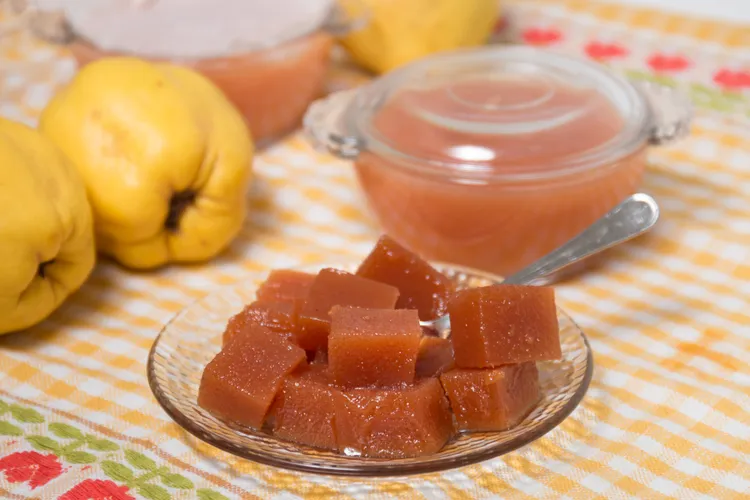
Fruit cheese is taken one step further than fruit butter. Where butter is thick and spreadable, cheese is cooked until it sets solid enough to slice and hold its shape on a board. The Spanish version made from quince - membrillo - is the most famous, but the same technique works for damson, quince, crab apple, and blackcurrant. A slice of quince paste alongside manchego or a mature cheddar is one of the better food combinations that exists.
How Fruit Cheese Differs from Jam
Jam sets because of pectin forming a gel with sugar and acid. Fruit cheese achieves its solid set through extreme reduction - the moisture content is cooked down so far that the remaining sugar and pectin create a dense, almost candy-like mass. There is no separate setting point to test for. The test is consistency: the paste should pull away from the sides of the pan cleanly and a spoon dragged across the base should leave a clear channel that holds. At this point the mixture is close to 70 to 75 percent solids and will set solid once cooled.
Best Fruit for Fruit Cheese
High-pectin fruit is essential. Quince is the classic because it has exceptionally high pectin and natural tannins that contribute to the firm, sliceable texture. Damson plums are the second-best option - very high pectin, intensely flavoured, and the deep purple colour of damson cheese is striking. Crab apple makes an excellent pale amber cheese. Blackcurrant works but is more expensive per kilogram than the others. Strawberry and raspberry fruit cheese is possible but requires added commercial pectin and is much harder to achieve a firm set.
The Long Cook
Fruit cheese takes longer to make than jam. After the initial puree, it needs 45 to 90 minutes of steady cooking on low heat, stirring frequently, as it reduces to a thick paste. The reduction phase is when sticking becomes a serious risk. Use a heavy-based pan, low heat, and stir every 2 to 3 minutes. A non-stick pan for this stage is fine - the temperature is lower than jam-making because there is no rolling boil involved.
Setting the Cheese: Moulds and Containers
Fruit cheese is poured into moulds to set. Traditional moulds are small, straight-sided ceramic or silicone containers that allow the cheese to be turned out whole onto a board. Silicone loaf tin liners work well. A standard loaf tin lined with cling film works adequately. Small individual silicone moulds produce neat rounds that look impressive on a cheese board. Pour the hot cheese in, smooth the top, and leave to cool at room temperature before refrigerating to set fully.
Recipe 1: Quince Paste (Membrillo)
Makes: 2 to 3 small loaves or moulds | Prep: 30 minutes | Cook: 60 to 90 minutes
Ingredients
- 1.5kg quince (approximately 4 large quince), peeled, cored, and roughly chopped
- Water to cover (approximately 500ml)
- Juice of 1 lemon
- Sugar (equal weight to the cooked quince puree, measured after cooking)
Instructions
- Place quince pieces in a large pan with water and lemon juice. Bring to a boil, then simmer for 25 to 30 minutes until completely soft. Quince takes longer to soften than most fruit.
- Drain, then blend or pass through a food mill to a smooth puree. Weigh the puree. Add an equal weight of sugar and return to the pan.
- Stir over low heat until the sugar dissolves. Increase to a medium-low heat and cook, stirring frequently, for 45 to 60 minutes. The puree will gradually change colour from pale yellow to deep amber or terracotta as it cooks and the sugars caramelise slightly.
- When the paste pulls away from the sides of the pan cleanly and a spoon drawn through it leaves a clean channel that holds for 5 seconds, it is ready.
- Pour into prepared moulds. Smooth the tops. Leave to cool completely at room temperature (this takes several hours), then refrigerate overnight before turning out.
- Wrap in greaseproof paper. Keeps refrigerated for 3 months.
Recipe 2: Damson Fruit Cheese
Makes: 2 to 3 moulds | Prep: 20 minutes | Cook: 50 to 70 minutes
Ingredients
- 1kg damsons
- 150ml water
- Sugar (equal weight to sieved puree)
Instructions
- Simmer damsons with water for 20 minutes until completely soft and skins burst. Press through a sieve to remove stones and skins. Weigh the puree.
- Combine with equal weight sugar in a heavy pan. Stir over low heat to dissolve.
- Cook over medium-low heat, stirring frequently, for 40 to 50 minutes until the paste is very thick and pulls cleanly from the pan sides.
- Pour into moulds. Cool and refrigerate. Keeps for 3 months refrigerated, or 6 months wrapped tightly in the freezer.
Serving and Pairing
Quince paste is the traditional pairing for manchego in Spain, but it works equally well with aged cheddar, comté, pecorino, or any hard cheese. Damson cheese pairs well with blue cheeses and rich pates. Both can be sliced thin and served alongside cold meats on a charcuterie board. A small cube of membrillo in a cheese toastie, melted alongside the cheese, is underrated. For a dinner party cheese course, a slab of membrillo costs almost nothing to make and replaces the shop-bought version entirely.
Nutrition (per 30g slice, quince paste)
- Calories: approximately 90 kcal
- Carbs: 23g (of which sugars 23g)
- Protein: 0g
- Fat: 0g
For the full overview of home preserving beyond jam, see the complete homemade preserves guide.
Sourcing Quince
Quince is not a supermarket fruit in most countries. In the UK, it is available from October at farmers markets, specialist greengrocers, and occasionally picked from garden trees (it grows well in temperate climates and a productive garden quince tree produces far more fruit than one household can use). Middle Eastern, Turkish, and Iranian grocery shops often stock fresh quince in season. Online fruit retailers stock them from October to December.
Crab apples are the most accessible substitute where quince is unavailable. They have similar pectin levels and produce an excellent amber fruit cheese, though the flavour is less complex than quince. Use the same recipe with crab apples and omit the longer softening time (crab apples soften faster than quince).
Troubleshooting Fruit Cheese
Fruit cheese that does not set firm: it was removed from the heat too early. The paste must be very thick and pulling cleanly from the pan sides before it is poured into moulds. If a set cheeese is too soft after 24 hours in the fridge, return it to the pan, add a tablespoon of lemon juice, and cook for a further 20 to 30 minutes. Fruit cheese that is too hard and brittle: it was cooked too long. It is still edible and useful in cooking (thinned with a little water or wine to make a sauce) but will not slice well.
Storage and Presentation
Fruit cheese keeps refrigerated for 3 months wrapped in greaseproof paper. For longer storage, wrap tightly in multiple layers and freeze for up to 12 months. To present on a cheese board, turn the cheese out of its mould (run a thin knife around the edge first) and slice with a sharp knife. If the cheese is very firm, warm the knife blade briefly under hot water for easier slicing. A slab of quince paste on a board next to cheese is one of those simple but effective presentations that looks considered without requiring much effort. For the full home preserving guide including chutney, pickles, and fruit curd, see the complete homemade preserves guide.
Quince Paste at Different Stages
An interesting feature of quince paste is that it is good at multiple stages of the cooking process. After 20 to 30 minutes of reduction from the puree stage, it is a thick jam - excellent on toast or as a glaze. After 45 to 60 minutes it is a soft fruit cheese, good for spreading but not yet sliceable. After 70 to 90 minutes it is membrillo - firm, sliceable, and the classic product. You can stop at any stage depending on your intended use. Making a batch and pouring half into jars as a thick jam (earlier) and half into moulds as a firm cheese (later in the same cooking session) is an efficient use of the quince and gives you two products from one session.
The colour change through cooking is dramatic and worth watching. Fresh quince puree is pale cream or very light yellow. As it cooks, it darkens through gold, amber, and eventually deep terracotta. This colour change is due to the oxidation and caramelisation of the fruit's natural phenols - no separate colouring is added. A pale quince paste that has not changed colour significantly has not cooked long enough. For the complete guide to home preserving including fruit jellies, chutneys, and pickles, see the complete homemade preserves guide.
Quince in the Broader Preserving Kitchen
Quince is one of the most versatile fruits in a preserving kitchen. Beyond paste and membrillo, it makes exceptional jelly (the pectin content is extraordinary), a very good jam that sets firmly even at reduced sugar, and a poached quince in syrup (a separate preserve entirely) that is stunning served with cream or custard. A single quince tree in a garden provides more fruit than most households can eat fresh, which makes all of these preserving applications practical rather than theoretical.
The firm texture and high pectin of quince also make it a useful addition to other fruit preserves. Added to low-pectin fruits like strawberry or pear in a 20 to 30 percent proportion, it contributes setting ability without dominating the flavour. Grated raw quince added to strawberry jam at the sugar stage boosts pectin and adds a subtle floral quality that most people cannot identify but notice as a general improvement in complexity. For the full guide to home preserving beyond jam and jelly, see the complete homemade preserves guide.
The History and Context of Membrillo
Quince paste has been made across Southern Europe and the Middle East for centuries. The Spanish version - membrillo - is the most internationally recognised, traditionally eaten alongside Manchego cheese as a table staple. The Portuguese version, marmelada, is the etymological origin of the English word marmalade (originally a quince paste, only later applied to the citrus preserve). Portuguese marmelada was brought to Britain and evolved into the citrus preserve we now know, while the original quince paste retained its original name in Iberia.
In Iran and Turkey, quince is used in savoury cooking as well as sweet - quince paste appears alongside lamb dishes, in rice preparations, and as a condiment with grilled meats. These culinary traditions suggest uses for homemade quince paste beyond the cheese board. A thin slice of quince paste melted into a pan sauce for duck or lamb adds sweetness, acidity, and body. A small cube dissolved in warm water and orange juice makes a glaze for a roasting joint. The flavour of quince - floral, astringent, sweet-tart - works in savoury contexts in the same way that redcurrant jelly does alongside lamb or Cumberland sauce does with cold meat. For the complete guide to home preserving including fruit jellies, chutneys, candied fruit, and potted foods, see the complete homemade preserves guide.
Quince Paste in Autumn Cooking
Beyond its place on a cheese board, quince paste has several useful autumn cooking applications. Thinned with a little water and orange juice over gentle heat, it becomes a glaze for a roasting joint of pork or lamb. A small cube dissolved into a pan sauce for duck adds sweetness and body without the heaviness of cream. Quince paste wrapped around brie or camembert (cut a thin slab, place on one half of the cheese, fold the other half over) before baking produces a starter that takes 5 minutes to assemble and 15 minutes to bake.
In pastry, quince paste as a filling in croissant dough, puff pastry turnovers, or inside a frangipane tart produces results that are distinctly better than the standard jam filling. The firm texture of the paste means it does not leak during baking the way jam does, and the intense quince flavour comes through the pastry without being diluted by steam. A frangipane and quince tart made in October with freshly made quince paste is one of the best autumn bakes and uses the paste in a context where its character is shown to best advantage. Quince and almond together is a classic Spanish combination for exactly this reason. For the complete guide to home preserving, see the complete homemade preserves guide.
Latest