Braised Oxtail: The Cut That Rewards Patience
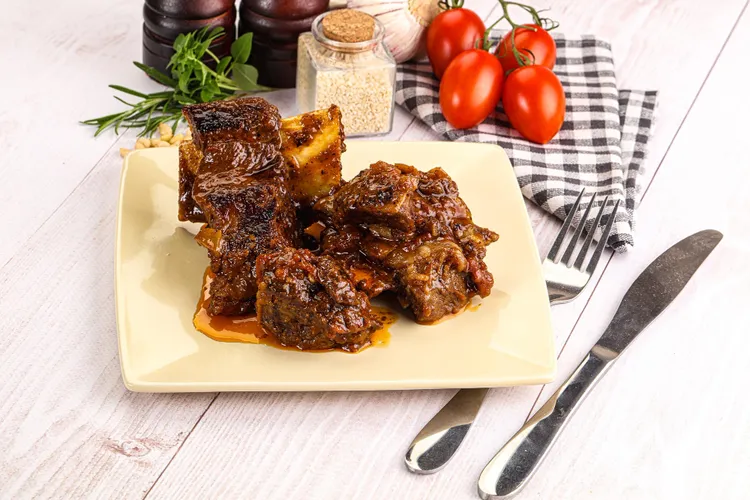
Oxtail is the most gelatinous cut on the animal. Braise it for 6-8 hours and the collagen converts almost entirely to gelatin, turning the braising liquid into a rich, glossy sauce without any thickening required.
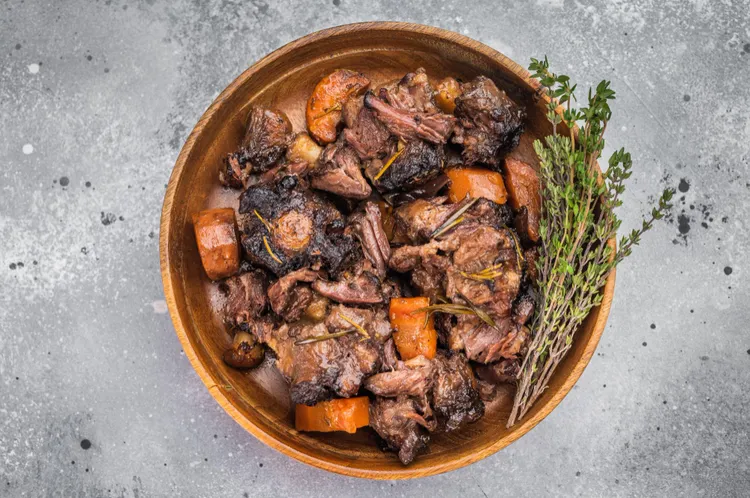
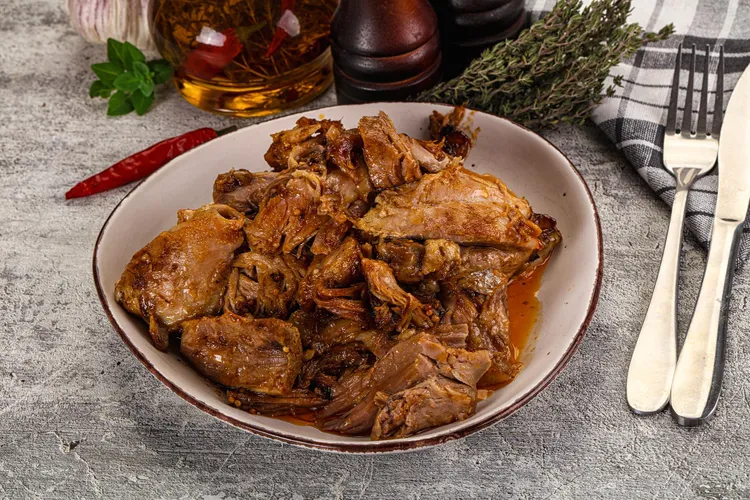
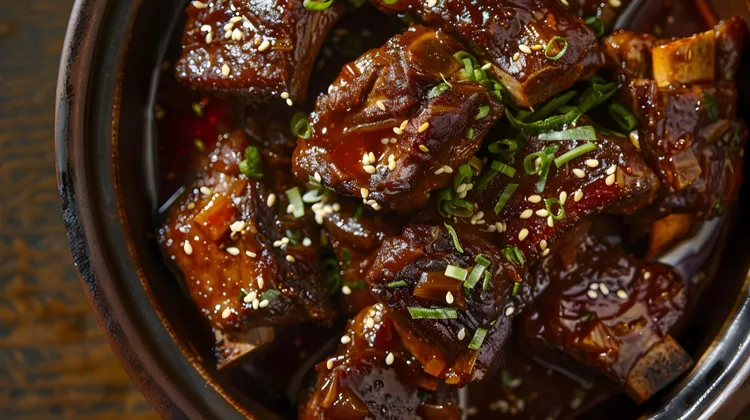
A kilo of raw oxtail produces roughly 350-400g of edible meat after a long braise - about 35-40% yield. That sounds low until you eat it. The meat that remains is extraordinarily rich, almost unctuous, and the braising liquid it produces has the consistency of a reduced stock without any actual reduction required. Oxtail is made almost entirely of connective tissue wrapped around a central vertebral bone. There's very little conventional muscle. That's the point: nearly all of it converts to gelatin during a long braise, and the result is unlike any other cut you can buy at the butcher.
Choosing and Preparing Oxtail
Oxtail is sold in cross-sections, each piece containing a central bone, a ring of meat, and dense connective tissue on the outer edge. Ask the butcher to cut pieces roughly 4-5cm thick - thinner pieces lose their shape during long cooking; thicker ones don't cook evenly all the way to the bone. A 1.5kg braise serves 4 people as a main course.
The outer fat on oxtail is thick and waxy. Trim the most obvious excess before cooking - leave the fat close to the bone (it renders and adds flavour to the liquid) but remove the large white exterior chunks. If the oxtail is fresh, soak the pieces in cold water for 30-60 minutes before cooking. This draws out residual blood and produces a cleaner, less iron-forward braising liquid.
The Sear and Aromatics
Pat the pieces completely dry and season well. Sear in batches in a very hot Dutch oven over high heat - oxtail pieces are awkward shapes, so take time to get colour on every flat surface available. Work in small batches and don't crowd the pan. A crowded pan drops temperature immediately and the pieces steam rather than sear.
After searing, reduce the heat and soften 1 large onion, 2 carrots, 4 celery stalks, and 6 garlic cloves in the same fat. Oxtail is assertive enough to handle strong aromatics without being overwhelmed. A tablespoon of tomato paste cooked for 2-3 minutes until it darkens adds concentrated acid and savouriness. A few anchovy fillets melted into the fat at the same stage add significant background depth - they dissolve completely and leave no fishiness, only umami. Generous black pepper works well here too - oxtail can handle it.
Liquid and Braising Setup
Deglaze with 250ml red wine and let it reduce by half before adding 400ml beef stock. Return the oxtail to the pot - the liquid should come about halfway up the pieces. Oxtail benefits from slightly more liquid than most braises because the cooking time is so long; the extra liquid compensates for more evaporation over a 6-7 hour oven cook.
Add a bouquet garni (thyme, bay, parsley stalks) and bring to a simmer on the stovetop before transferring to the oven or slow cooker. For the best possible braising liquid, start with a rich homemade stock - our guide to making stock at home covers beef stock in detail. For wine selection, our guide to red wines for braising covers the options - Rioja, Malbec, and Merlot all work well with the intensity of oxtail.
Timing and Temperature
- Oven at 150°C (300°F), lid on: 6-7 hours. Lower and slower than most braises. The dense connective tissue in oxtail needs more sustained time at temperature for full collagen conversion.
- Slow cooker, low setting: 9-10 hours. Excellent - the overnight cook is ideal for oxtail. Load it before bed, wake up to a finished braise.
- Slow cooker, high setting: 6-7 hours. Slightly firmer texture but still very good.
Oxtail is done when the meat pulls cleanly from the bone with light finger pressure and the braising liquid has visible viscosity - it coats the back of a spoon even before any reduction. If the liquid still looks thin and watery, the collagen hasn't fully converted. Give it another 45 minutes and check again. Under-cooking oxtail is far more common than over-cooking it.
For comparative timing across other cuts at the same settings, see our slow cooker timing guide.
Finishing and Sauce
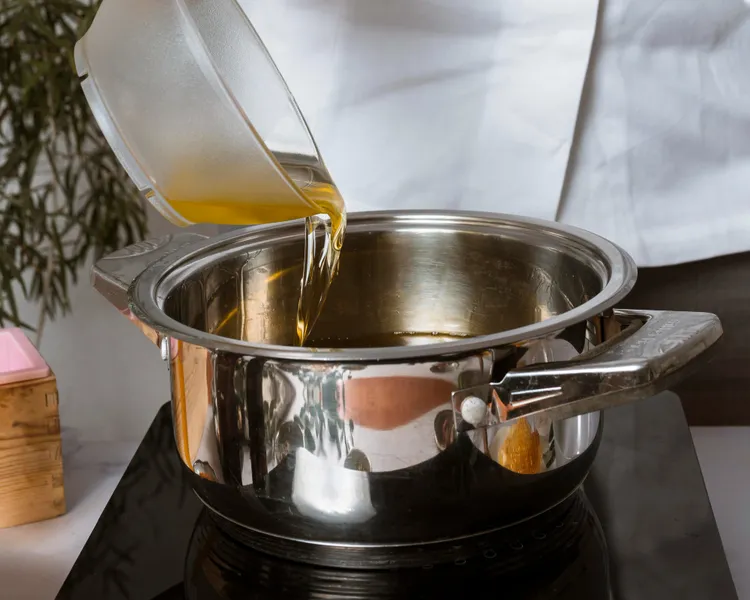
Remove the oxtail pieces and set aside. The braising liquid at this stage is the highlight of the dish - don't waste it. Strain through a fine sieve, pressing the softened vegetables firmly. Skim as much fat as possible from the surface. There will be a lot from oxtail - more than from almost any other cut.
For the cleanest sauce: refrigerate the strained liquid overnight, uncovered. The fat solidifies on the surface into a solid disc that lifts off in one clean piece, leaving a perfectly lean, intensely flavoured sauce base underneath. This overnight step is worth doing if you have the time - it produces a sauce with clarity and depth that's impossible to achieve through hot skimming alone.
Reduce the defatted liquid over high heat to sauce consistency - it should coat a spoon cleanly. Taste and adjust: a teaspoon of soy sauce rounds out the umami. Finish off the heat with a small knob of cold butter, swirled in to emulsify, for a glossy sheen that clings to the meat.
Pick the meat from the bones before serving. It's more practical and ensures each person gets even portions of the richest meat rather than one person getting the larger pieces by luck.
Serving and Macros
Oxtail is traditional over polenta, mashed potato, or wide pasta (pappardelle especially). The richness of the meat demands something starchy to balance it. A 200g serving of picked oxtail meat with 50ml sauce: approximately 380-420 kcal, 28-32g protein, 2-4g carbs (from sauce), 26-30g fat. The fat content is significant - oxtail is not a lean protein source - but the portion size is naturally smaller due to its intensity and richness.
Meal Prep and Storage
Oxtail braise is one of those dishes that's notably better on day two. Refrigerate the whole pot overnight - the braising liquid sets to a trembling jelly and the flavours deepen as everything melds together. Reheat gently; the sauce melts perfectly with low heat. Keeps for 4 days refrigerated, 3 months frozen. Freeze in portions with sauce - the sauce is essential for reheating without the meat drying out.
For batch cooking strategy including oxtail as part of a week of meals, see our braising for meal prep article. For the complete low-and-slow technique foundation, see the slow cooker and braising guide.
Why Oxtail Takes Longer Than Other Cuts
The unusual structure of oxtail explains why it needs significantly more time than lamb shoulder or short ribs at the same temperature. Most braising cuts have connective tissue running through the muscle - the muscle itself is the main ingredient. Oxtail is structured differently: thin layers of meat wrap around the bone, and the tissue between those layers is almost entirely collagen rather than muscle fibre. There's comparatively little conventional muscle.
That dense connective tissue needs extended time at temperature to fully convert. Pulling oxtail at 5 hours when it's technically edible but the braising liquid is still thin means the collagen conversion is incomplete. At 7-8 hours, the difference in the sauce body and meat texture is pronounced - this is not a cut where you can hurry the process.
Serving Variations
Oxtail preparations vary widely by culture, and all of them use the same fundamental braising technique.
Caribbean oxtail stew: kidney beans, whole scotch bonnet, allspice berries, and a splash of browning sauce. Heavy on garlic and ginger. Serve with rice and peas - the braising liquid doubles as sauce for the rice.
Roman coda alla vaccinara: the classic Roman preparation using tomatoes, celery, dark chocolate, pine nuts, and raisins in the braise. The combination sounds unlikely; the result is intensely savoury and complex.
Korean kkori gomtang: the simplest approach - oxtail simmered in plain water for 8 hours with garlic and ginger until the broth turns milky white from dissolved collagen. Season only at the table. Serve with rice and spring onions.
The Overnight Approach
Of all braising cuts, oxtail most rewards starting it the night before. Set the slow cooker on low before bed, come back to a finished braise in the morning, and chill the whole pot. The solidified fat disc lifts off in one clean piece, leaving a perfectly defatted braise ready to reheat for dinner. The texture after chilling and gentle reheating is arguably better than serving immediately from the slow cooker - the gelatin sets fully and the flavours deepen further.
Making Oxtail Accessible as a Regular Cook
Oxtail has a reputation as a special occasion cut, partly because of the long cooking time and partly because it requires advance planning. But the overnight slow cooker approach removes both barriers. Load it on a Sunday evening, come back Monday morning, chill the pot while you're at work, and defat and reheat for Monday dinner. The active hands-on time is under 30 minutes; the rest is the cooker doing its job.
The cost argument also runs in oxtail's favour. It's significantly less expensive per kilo than lamb shoulder or short ribs in most markets, and the yield - while lower - produces a more intensely flavoured result. A 1.5kg oxtail braise feeding four people at 150g picked meat portions is an economical and exceptional dinner.
Storing and Using the Braising Liquid
The braising liquid from oxtail is so gelatinous and flavourful that discarding any of it is a significant waste. After the main serving, reduce any leftover liquid to a very concentrated glaze and freeze in ice cube trays. These frozen cubes dissolve into pasta sauces, risottos, or braises of other cuts to add instant depth. They keep for 3 months in the freezer and are one of the most useful flavour building blocks you can keep on hand.
If you've picked all the meat from the bones, the liquid can also be used as the base for a bone broth - simmer the spent bones in the already-rich liquid for another 2-3 hours, then strain and chill. The resulting liquid will be extraordinarily gelatinous and useful across many preparations.
Oxtail in Different Cuisines
Few cuts are as globally consistent in their preparation as oxtail. It appears in braised or stewed form across Caribbean, West African, Italian, Korean, Chinese, and British cooking traditions, all using essentially the same technique: long, slow, wet cooking to extract collagen and produce a deeply flavoured sauce. The aromatics and accompaniments differ, but the fundamental approach - oxtail, liquid, low heat, time - is constant across all of them.
This cross-cultural consistency tells you something about the cut itself. Wherever cattle were raised and slaughtered, the tail posed the same challenge: too much connective tissue for direct-heat cooking, too much potential flavour to discard. The braising solution was arrived at independently across multiple cultures, which suggests it's simply the correct approach to the ingredient. Cook it low and slow in flavoured liquid and it becomes exceptional. There is no shortcut that produces the same result.
The economics of oxtail braising work strongly in its favour. It's significantly less expensive per kilo than other braising cuts of comparable quality, the yield is lower but the flavour intensity is higher, and the braising liquid it produces - that exceptional gelatinous sauce - is arguably more valuable than the meat itself. A single oxtail braise produces enough rich, reduced braising liquid to improve half a dozen other dishes during the week. For cooks who think about cooking as a connected set of preparations rather than isolated meals, oxtail is one of the highest-value cuts you can buy.
The patience oxtail demands is not a drawback - it's exactly what makes it worth cooking. There are few better uses of a slow cooker's 10-hour window than a cut that emerges completely transformed, with a sauce that no other preparation could produce from the same ingredients and the same amount of active work.
Add oxtail to the regular rotation alongside lamb shoulder and beef chuck. It costs less, produces a more interesting sauce, and rewards exactly the low-maintenance approach that makes braising worthwhile for weekday batch cooking.
Latest