Why We Eat Certain Foods on Certain Holidays
Pancakes used up Lenten eggs, matzah left no time to rise, and Spain's twelve grapes may have been a surplus sale. Nine holiday foods and the practical, religious or lucky reasons behind them.
Ask someone why they eat a particular dish at a particular holiday and the answer is usually "because we always have." The always turns out to be shorter, stranger or more practical than it feels. One tradition started as a way to use up eggs before a fast. Another may have started as a way to sell off a grape surplus. And the turkey probably was not on the table at the first Thanksgiving. Here are nine holiday foods and the reasons behind them, sorted by what actually drove the habit.
Foods Born From Fasting Rules
For centuries, Lent and other fasts decided what could be in a Christian kitchen and when. Three familiar holiday foods exist because of what had to be used up or given up.
Why Do We Eat Pancakes on Shrove Tuesday?
Because eggs, butter, milk and fat were off the menu for the 40 days of Lent, and pancakes were an easy way to use them up. Shrove Tuesday is the day before Ash Wednesday, the first day of Lent.
Before refrigerators, perishable ingredients that could not be eaten during the fast would spoil if left. The day before Lent became the last chance to cook through them. Meat went first, on the Monday known in parts of Britain as Collop Monday, and then the eggs, butter and stored fat went into batter. The French name for the day, Mardi Gras, means Fat Tuesday for the same reason. The custom outlasted the rule. By the 18th century the English cook Hannah Glasse was printing a Lenten pancake recipe with no eggs or dairy at all, which suggests that the pancakes themselves had stopped being only about using things up.
The batter is still worth getting right. Eggs and butter are the main ingredients, which is why it matters whether they are cold or at room temperature, as we explain in why recipes ask for room temperature eggs and unsalted butter.
Why Are Eggs and Ham on the Easter Table?
Eggs were forbidden during Lent, hens kept laying anyway, and by Easter there was a surplus. Medieval rules banned meat, eggs and milk foods during the fast, and the theologian Thomas Aquinas, in the 13th century, spelled out that eggs were included because they come from animals that provide flesh.
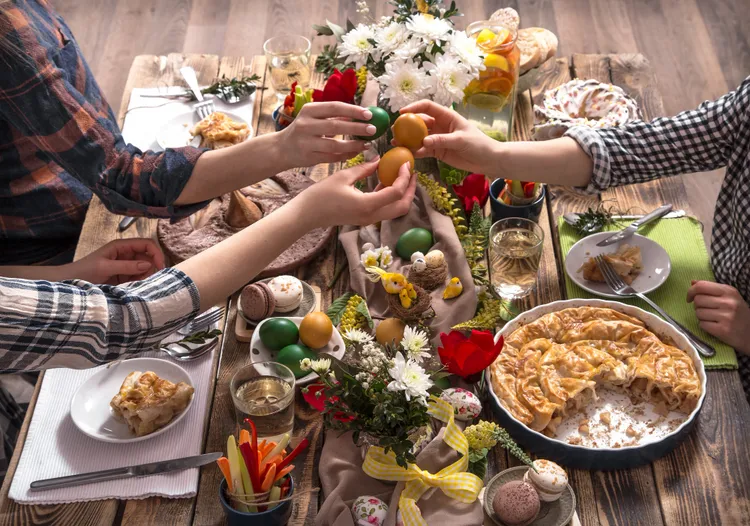
Hens do not stop laying for Lent, so households ended up with a large supply. Many were hard-boiled to keep them, and eggs became a natural gift at Easter. A record from 1290 says that England's Edward I had eggs boiled, stained or covered in gold leaf and handed out to the royal household at Easter. Many Orthodox Christians still dye their eggs red, which they say represents the blood of Christ, and the egg is widely read as a symbol of new life and the empty tomb. Chocolate eggs came much later, from confectioners in the 19th century.
Ham has a similar practical logic. According to one historian, pigs were slaughtered in the fall, cured over the winter and ready to eat in spring, which is when Easter falls.
Why Do Some Families Eat Fish on Christmas Eve?
Because Christmas Eve was traditionally a day of abstinence from meat in the Catholic Church, so the feast was built around fish and meatless dishes. The Church no longer requires it, but the habit stayed in many families.
In Poland, the Christmas Eve supper is called Wigilia, from the Latin for vigil. It begins when the first star appears, contains no meat and traditionally has twelve dishes, one for each of the apostles. Fish, often carp, is the main course. In southern Italy the same evening is called la Vigilia. The famous Feast of the Seven Fishes is mostly an Italian-American name. A seven- or thirteen-fish Christmas Eve meal is documented in Calabria, but a Saveur editor told NPR that one food expert compared "seven fishes" to veal parmigiana, meaning the label is more Italian-American than Italian.
Foods That Retell a Story
For some holidays the food is a way of remembering something. The dish is the text.
Why Do Jewish Families Eat Matzah at Passover?
Because, according to the Book of Exodus, the Israelites left Egypt in such a hurry that their bread had no time to rise. The relevant verse says the dough they took out of Egypt was baked into unleavened bread because they were driven out and could not delay.
During Passover, leavened grain foods, known as chametz, are forbidden, and matzah takes the place of bread. The rule is strict. By tradition, no more than 18 minutes can pass between water first touching the flour and the matzah coming out of the oven, since that is the point at which fermentation is said to begin. Matzah is also called the bread of affliction or poor bread, and it is a central part of the Seder meal.
Why Are Fried Foods Eaten at Hanukkah?
Because Hanukkah commemorates the story of a small amount of oil that burned for eight days in the rededicated Temple in Jerusalem. Foods fried in oil are a way of eating that story.
The miracle account itself appears in texts much later than the events it describes, nearly 600 years later according to some historians. The foods have changed with the geography. Italian Jews are said to have eaten fried cheese pancakes. Sephardi Jews make fried fritters called burmuelos. Eastern European Jews eventually settled on the potato latke, but only in the 19th century, because potatoes did not become a common food in Eastern Europe until then. Before that, latkes were more likely made of cheese. The jelly doughnut, or sufganiyah, became the dominant treat in Israel, where bakers sell more than 20 million during the holiday, and reached many American households only recently. If you are curious about where the potato came from in the first place, see the surprising origin of everyday foods.
The frying fat in Eastern Europe was usually chicken or goose fat, not olive oil. If you are frying at home, our guide to which olive oil to cook with covers what holds up to heat.
Why Do Muslims Break the Ramadan Fast With Dates?
Because the Prophet Muhammad is reported to have broken his fast with fresh dates, then dried dates, and with water if there were none. Many Muslims follow that practice at iftar, the evening meal.
A widely cited report from Anas ibn Malik says the Prophet would break his fast with fresh dates before praying, and if there were none, with dry dates. Eating dates is encouraged but not required. There is also a practical side, since dates are a quick source of sugar after a day without food, and a few of them make a gentle start before the main meal. Many varieties are used, from small, dark ajwa dates to large, soft medjool dates.
Foods That Carry a Wish
Some holiday foods are chosen for what they sound like or look like. The reasoning is closer to wordplay than to rules.
Why Do People Eat Dumplings, Fish and Noodles at Lunar New Year?
Because each dish stands for something people want in the coming year, usually through its shape or its sound. It is one of the clearest cases of food as a wish.
The Mandarin word for fish, yu, sounds like the word for surplus, and a whole fish on the table is a wish for abundance every year. Leaving some of it over until the next day is meant to carry the surplus into the following year. Dumplings are shaped like the gold and silver ingots used as currency in imperial China, so a plate of them looks like a pile of money, and the more you eat, the more prosperous you are said to become. Longevity noodles are extremely long and are served uncut, since breaking them would shorten the life they stand for. Round foods such as tangyuan are for family unity.
Why Do Spaniards Eat Twelve Grapes at Midnight?
The tradition is called las doce uvas de la suerte, the twelve lucky grapes, and its origin is disputed. One grape is eaten for each chime of the clock at midnight on New Year's Eve, for the twelve months of the year.
One popular story says winemakers in Alicante invented it in 1909 to sell a bumper crop. Newspaper research suggests it is older. It may go back to the 1880s, when Madrid's upper classes copied the French habit of eating grapes with champagne on New Year's Eve, and ordinary people then took up the grapes as a way to mock them, gathering at the clock in the Puerta del Sol. Whichever is true, the tradition has spread across Latin America. The traditional grapes are white Aledo grapes from Alicante, grown in paper bags to protect them. They are usually sold in packs of twelve, and finishing them before the last chime is harder than it sounds, particularly since many Spanish grapes have seeds.
Was Turkey Served at the First Thanksgiving?
There is no solid evidence that it was. The 1621 gathering in Plymouth Colony between the Pilgrim settlers and the Wampanoag is the event Americans have in mind, but surviving accounts do not give a menu that centers on turkey.
Turkey became the holiday bird gradually. Settlers inherited the medieval European habit of serving large wild fowl, and turkey, native to North America, was available and large enough for a crowd. The writer and editor Sarah Josepha Hale did much of the rest. She described a Thanksgiving table with roast turkey in an 1827 novel and spent years campaigning for a national holiday. By 1854 more than 30 states and territories held a Thanksgiving, and in 1863 Abraham Lincoln declared the last Thursday in November a national holiday.
If you are cooking a bird for a crowd, remember that the breast and the thigh cook very differently. The logic in our guide to chicken cuts compared applies to turkey as well.
A few patterns repeat. Many foods exist because of a rule about what could not be eaten, and the food survived long after the rule was relaxed. Others began as a practical use for a surplus, whether eggs, fat or grapes. Some are chosen for what they sound like or look like. And a few are newer than they feel: potato latkes date to the 19th century, and the Thanksgiving turkey owes much of its fame to one editor's campaign.
The takeaway is that the explanation people give for a tradition is not always the oldest one. A tradition can carry a religious meaning, a practical origin and a later layer of marketing all at once, and the meaning is no less real for having a practical history.
Quick Answers
Why do we eat pancakes on Shrove Tuesday?
Eggs, milk, butter and fat were forbidden during Lent, so pancakes were a way to use them up on the day before the fast began.
Why are eggs associated with Easter?
Eggs were banned during Lent, hens kept laying, and the surplus was boiled and eaten or given as gifts at Easter. The egg is also a symbol of new life.
Why do some families eat fish on Christmas Eve?
Christmas Eve was traditionally a day of abstinence from meat in the Catholic Church, so the meal centered on fish and meatless dishes.
Why is matzah eaten at Passover?
According to the Book of Exodus, the Israelites left Egypt in such haste that their dough had no time to rise, and matzah recalls that.
Why do people fry foods at Hanukkah?
Hanukkah commemorates the story of a small amount of oil that lasted eight days, and foods fried in oil recall it.
Why do Muslims break their fast with dates?
The Prophet Muhammad is reported to have broken his fast with dates, and many Muslims follow that practice at iftar.
Why are dumplings eaten at Lunar New Year?
They resemble the gold and silver ingots of imperial China, so eating them is a wish for wealth in the coming year.
Why do Spaniards eat twelve grapes on New Year's Eve?
One grape is eaten at each of the twelve chimes at midnight for luck in each month of the year, and the origin is disputed.
Was turkey eaten at the first Thanksgiving?
There is no solid evidence that it was. Turkey became the standard holiday dish over the following centuries, helped by writer Sarah Josepha Hale.
Latest